Showing posts with label theatre. Show all posts

Invisible Circus (1946) and Interval (1939) by Sumner Locke Elliott

Two stage plays by Sumner Locke Elliott.  Done at the Independent.

 Interval

1939 play. Review in SMH here.  Locke's second play, after The Cow That Jumped Over the Moon. Played in every state. Published in a collection in 1942 see here.

AustLit here. Someone did a thesis on it here.

Premise 

Set behind the scenes of a theatre during a two year run of a play in London.

Invisible Circus

Runs in 1946. About radio. Review is here

Austlit here. Excerpt on line is here.

Leslie Rees, Towards an Australian Drama


Lists of Australian Plays in Leslie Rees Book Towards an Australian Drama

 From 1953


"Who'll Come a Waltzing" (1963 play)

A 1963 Australian comedy play by South African born Peggy Caine who had emigrated to Australia three years previously. The premise of the play was about British migrants in Australia.

It was staged by J. C Williamson's in the major cities of Australia, at a time when that company rarely put on Australian plays. It was adapted for radio in Australia, England and New Zealand.

It was first performed for radio in Dec 1962. See here Replayed in June 1963 see here.

The original production featured Campbell Copelin, Marion Johns, Isla Tait (daughter of Frank Tait see piece here),

 Premise

The Eldred family arrive in Sydney and move to a rambling home in an outer suburb. When they have trouble making ends meet, Mrs Eldred takes in boarders, passing them off as family friends to avoid her husband's disapproval. 

Background

Peggy Caine moved from South Africa to Sydney in 1959. "I think I've put most of what I know about Australia into this play" she said. See here.  She was married with kids.

History

Play made debut in Feb 1963 directed by Richard Campion at St Martin's Theatre. JC Williamsons produced it with them I think.

Had a sell out season over four weeks. Decided to transfer it to a larger theatre and take on tour.

Ran in larger theatre in May 1963 see here. Williamsons gave it a five week season in Sydney starting in July 1963 see here. SMH review here. This account here says it was a "huge flop" in these large theatres although the play had a successful run in Adelaide.

John McCallum said the play caused them a financial loss. See this Variety piece here.
 

ABC

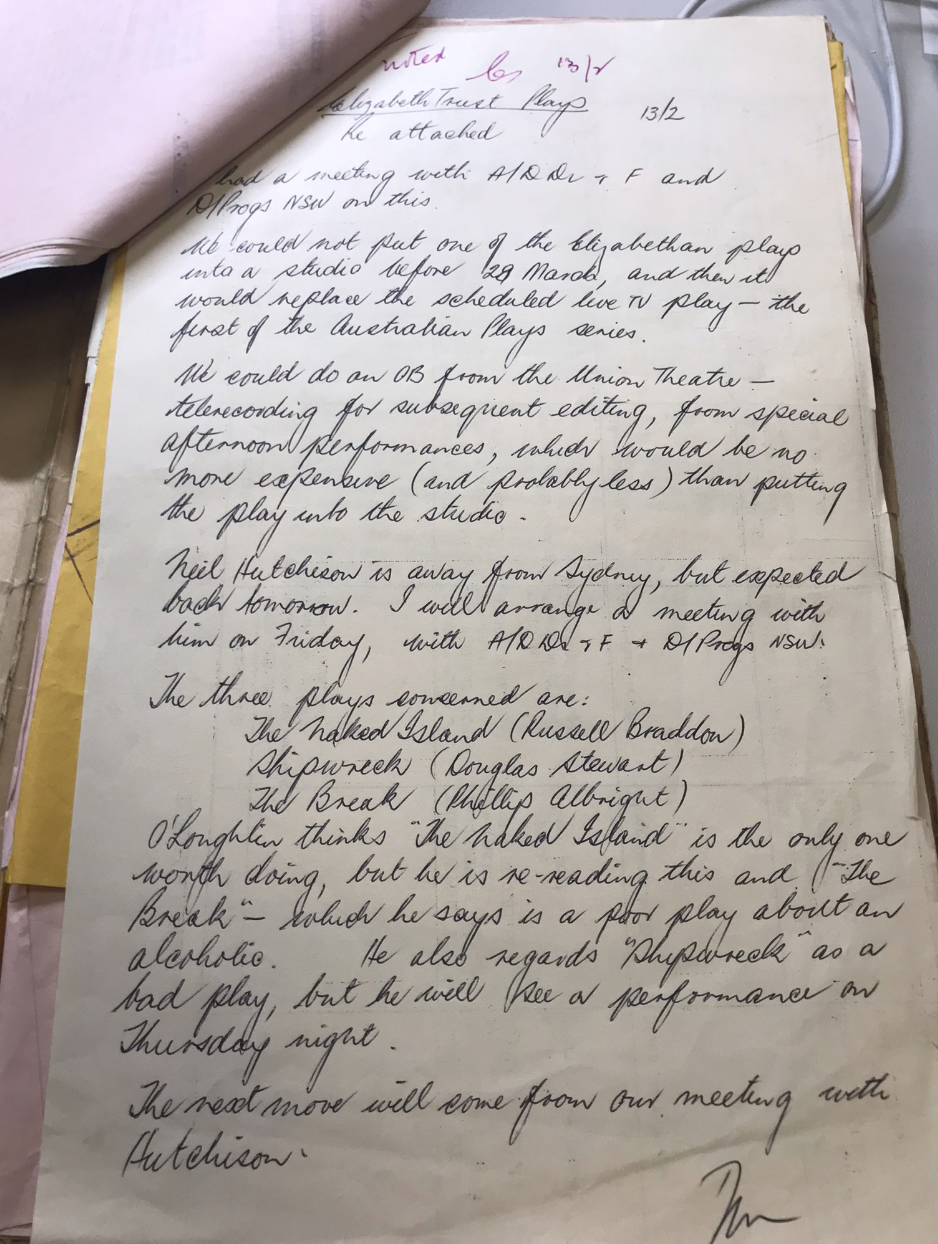
Paul O’Loughlin decreed it was “not worthy of” the “expense of a TV production.”

Ausstage listings here


Montreal Star 8 Feb 1964

SMH 11 Jul 1963

SMH 19 June 1`963

Age 22 Feb 1963

Museums Victoria


Variety 8 Jan 1964

Mischief in the Air by Max Afford (1944)


 Plays by Max Afford

Premise

The action takes place in a Rex Broadcasting Studios, a station  owned by Larry Carlson, a former Australian soldier, and Clay Tuttle, an American serviceman. Larry manages the business while Clay writes scripts. Larry is engaged to Fern, a doctor. Larry and Clay need the interest of sponsors Mc McGuinness, a Scotsman and Mr Mandelberg, a Jewish new Australian, but problems arise when the former falls dead.  Fern figures out it was due to poison.

Other characters include novelist Mrs Van Leydon, studio supervisor Arnold Vickery, actor Clarence Parsons and his wife Muriel. Fern, Larry  and Clay decide to hide McGuinness' corpse until Mandelberg signs the deal.  But it turns out the dead person isn't McGuinness. It's McGuinness' brother a Commonwealth Investigations officer investigating foreign spies working at Woomera and broadcating in code. The trio decide to solve the case themselves.

While they are figuring out who poisoned Charles McGuinness (the killer used poisoned darks bought by Van Leydon a New Guina expert), the real McGuiness wants to arrive. Mandleberg loses his diamond ring. They think the agent is Vickery. Fern persuades Mandleberg to sign the contract. Then Charles McGunnis comes back to life. He was paralysed. They realise Vicket is innocent (Fern tells them they read the note in his pocket wrongly).

Fern, who becomes the lead, realises the killer is Van Leydon - she used a lipstick device as a blow pipe. Van Leydon is about to kill Fern but is disrupted by a murder mystery play that is on.

Thoughts on play: Okay. Fast. Good that the women characters, Fern and Val Leydon, had jobs. Depiction of Jewish businessmen. Dodgy plotting. It could be fun.

Complete text is here via Gutenberg or here via Austlit.  First performance with JC Williamsons although in an early session.  Done in conjunction with 2GB and Macquarie see here.

Ausstage is here. Austlit is here.

SMH review:

NEW AUSTRALIAN PLAY AT ROYAL
Smoother development of mystery and comedy make Max Afford’s “Mis- chief in the Air,” which was pioneered at the Theatre Royal last night, a more satisfying play than his “Lady in Danger.” In this latest play, which a capacity audience enjoyed, Mr. Afford is clearly over-sworn to intricacies of plot many of them neat and engaging rather than to plausibility of psychology In his characters. Mr. Afford makes the mistake of continuing his story too long after the real denouement so that there is complete anti-cllmax and no real “capping” at his final curtain. While the craftsmanship with which he has built up his suspense and a couple of most entertaining “red herrings” is admirable, it is also plain that the intricacy of his plotting has not left a great deal of theatre art to producer or cast. The producer, John Alden, would be wise not to allow his funny man, Edwin Finn, to be such a buffoon as to destroy the audience’s chances of taking him seriously at a time when he should be taken seriously. Mr. Finn’s prim, managerial character Is overdone; so, In rarer spots, is Edward Howell’s rather clever Jew. Alleen Britton and John Mccallum in the central roles are adequate, despite obvious limitation of gesture and expression to a standardised series of tricks.-L.B.

Daily Tele

TP anything was necessary for Max Afford to establish himself as an outstanding Australian playwright, he has produced it in his new comedy thriller, “Mischief in the Air,” current “five-thirty” show at the Royal. It is an ingenious, plausible tale, with smart, up-to-the-minute dialogue, suspense, continual surprise; a moment of horror. The story tells of the efforts of two discharged servicemen — one Australian, the other American — to establish a radio station, and the complications that ensue when an attempt is made to murder a National Security Officer sent to discover who is using the station to send messages to the Japanese. The cast is headed by pleasant- voiced John McCallum and attractive, competent Aileen Britton. Ed win Finn was more than excellent as the studio manager who is so upset by everything that he “wishes he had never left the ribbon counter.” Edward Howell was less happy as the “omen” — conscious sponsor — the type of refugee who, “given a door handle and a roller-blind, finishes up with a block of flats.” — N.K. ? 

Leslie Rees, Towards Australian Drama


Play review - Day Before Tomorrow by Ric Throssell


Accused of being communist propaganda here

First produced on stage in Canberra in April 1956. Review of that is here from Canberra Times and in Bulletin here.

Played in Melbourne during Olympic Drama Festival in 1956with two other Australian plays - Under the Coolibah Tree and Pacific Paradise. See here. Competition from Victorian Drama League.

 On ABC radio in June 1956 see here. Taken to France. See here.

The Cardiff University Players performed it in 1958 it is reviewed here. It was performed at Edinburgh Festival in 1960 see here. Also performed in Perth and Hobart see here.

The play was published in 1969 it is reviewed by the SMH here.  Review by Canberra Times here.

Plot - see here

It tells the story of a journalist, his wife and their young daughter who have survived an atomic war, and now live in a bomb-wrecked hovel, looking out over a desolate countryside. The fight for survival has reduced them to complete moral degradation. Jackson and his wife realise and accept the fact that their daughter Carolyn sells herself for the food which keeps them just alive. Their nearest neighbour is Raw-lings, once a successful and genial chemist, but driven insane by his exneriences. Then comes the first relief squad from the outside area untouched by the bomb blast, bringing supplies of food, and hope for the future. The rescuers are not able to understand properly the way the survivors think and react, for the;> have merely looked on at the horror without themselves experiencing it. It is not surprising, therefore, that almost immediately a piece of petty tyranny brings tragedy.

Reviews 

The Age called the radio play "just about as dull as it could be". Thie was "Airel" who disliked Australian writing. See here

Pacific Paradise by Dymphna Cusack (1955)

 Stage and radio play by Cusack.

Austlit here

Finalist in PAB competitoin. eric Portman considered it for TV. See here.

First produced at the Waterside Workers Theatre, Sydney, 26 November 1955 (reviewed here) and on ABC radio, January 1956.(Along with two other new Austrlian plays The Hermit Crab and The Bombora) Letters of praise to that here and here
ABC play was to be on Dec 1955 but postponed due to NSW election see here
 
Play was popular in China and Cusack was invited to tour there see here. Went for six months in 1957 see here.

In addition, by 1962 the play had been produced in New Zealand, the UK, Japan. Latin America, the USSR, Czechoslovakia, Poland, Hungary, Germany, China, Albania, North Korea, Rumania, Bulgaria, Cuba, Iceland. 
 
Premise
 
The play tells of the island of Moluka in the South Pacific, where the enlightened inhabitants live an almost Utopian existence under the rule of a white man, Simon Hoad, to whose family the island was given by Queen Victoria a century ago.  Hoad is married to a native woman and has a daughter Laloma.

Their existence is threatened when they are informed that a new super-bomb is to be exploded on a neighbouring island and that they must be evacuated. 
 
Scientists and officers visit Moluka to put their case and bring pressure. Hoad refuses to leave and seeks to enlist the sympathies of people all over the world in his fight to be allowed to survive in his island paradise. 

ABC CAST  see here and here
Simon Hoad - John Tate
Clive Everett - John Meillon
Laloma - Wynn Nelson
Professor Nicholas - Edward Howell
Colonel Winterton - Joe McCormick
Niti - Margaret Christensen
Hon. Osbert Day - Moray Powell
Citole - Lola Brooks
Talua - Betty Lucas
K-ahru - John Bluthal
Batah - Keith Buckley
American Announcer - Richard Meikle
Narrator, Australian Announcer - Ric Huttor Producer: Eric John   

Review is here.
Play accused of being Commie propaganda by a moron on the ABC Weekly see here.


Propaganda Plays? DURING 1956 the A.B C. has broad- cast several plays, including Pacific Paradise and The Day After Tomorrow, which contain subtle Communist propa- ganda. The proof of this statement is to be found in Tribune, a Communist publication which recommends its read- ers to listen to these plays. What is of even greater significance, Pacific Paradise has been given a re- peat performance by the A.B.C. and 1 understand The Day After Tomorrow is to be repeated during August, owing to popular demand. This ‘‘popular demand” is created by Communist leaders instructing members and fellow-travellers to deluge the A.B.C with letters and ’phone calls expressing admiration concerning the plays referred to, and the A.B.C. has apparently fallen for this old manoeuvre. 
P. C. KENT. Cremorne, N.S.W. 
The A.B.C. Director of Drama and Features, Mr. Neil Hutchison, replies:— 
The description of these two plays as Communist propaganda is baffling. Paci- fic Paradise concerns the protest of an island community at being removed from their homeland, with the alternative of being wiped out by a bomb exploded 100 miles away—a wholly imaginative story of an imaginary island. Many serious-minded and responsible people fear that the atom bomb may not only result in horrifying genetical changes in those whom it indirectly affects, but also that it may eventually obliterate what we know as Western Civilisation. These people belong to all parties and cannot be described as Communists. Pacific Paradise is a good play, the characters are real and the development has integrity. The play was recently entered for a competition run by the Playwrights’ Advisory Board, was read by many qualified judges (some of whom are known to hold very strongly anti- Communist views), and reached the finals. No comment on these grounds was made by any of the readers. The Day After Tomorrow also con- cerned the hydrogen bomb, and tried to envisage the terrible result of its use, and how humanity, well nigh obliterated by its dreadful impact, might climb back slowly and painfully to dignity and self respect. I find it very hard to see the influence of Communist propaganda at work in these two Australian plays. It is perhaps germane to the issue to remark that holders of extreme political opinions habitually see their opponents as ex- tremists. I am not suggesting that Mr. Kent belongs to this category bur simply that he has cried wolf after having sighted a puppy dog.

Awake My Love (1947) and Dark Enchantment (1949) by Max Afford

Dark Enchantment (1949)

A young girl whose early fascination for a foreign ventriloquist leaves her with his doll, £1,000, and an accompanying "dark enchantment".'

Austlit here. First produced Minerva Theatre Sydney in 1949. His wife Thelma did costumes see here.

 then toured England in 1950. Hubert Woodward backed it see here. He rewrote it for Nora Pilbeam and is had a second provincial run see here.

Set in a London boarding house of 1895.

Adelaide News review here. The Truth review here. The Sun here. Another Daily Tele review here. Smiths Weekly here. Sydney Jewish News here. Bulletin review here.

Dail Tele review

 "Thriller" disappoints
Max Afford seems to have written his thriller, "Dark Enchantment," with an ear for the radio rather than an eye for the stage. This Australian author's play, which had its Minerva premiere last night, left most of its. thrills to explanatory— and trite — dialogue. Set in a London theatrical lodging-house of, 1895, “Dark Enchantment” clusters murder and mystery around the doll left by a dead ventriloquist. Max Afford failed to give his good, if derivative, thriller idea any sense of period character and atmosphere. He certainly created the sus pense in Act 2 when the ventriloquist’s doll became as frightening as the Monkey’s Paw of W. W. Jacobs. The cast handling this idea was mostly colorless and deficient in timing. Neva Carr-Glyn, whose seasoned technique carried the improbable gipsy role, Betty Duncan as the Victorian maid, and Charles Zoli in the obvious ‘role of the organ grinder, were the exceptions. Richard Parry as the ventriloquist. who should establish the mood in Act 1, was lament ably miscast. Producer Fifl Banvard failed to establsh both the essential points of the play and its latent melodrama. But the promise in “Dark En chantment” is strong enough to demand reconstruction by M& Atrora. — J.U’JN.

SMH review here.

First Night For A New Thriller  
Max Afford’s mystery thriller, “Dark Enchantment,” was pre- sented for the first time last night at the Minerva Theatre The author of “Awake, My Love,” has turned m this new play to the modest dimension of ;nclo dramg, in which he proves his ability to lease with suspense and to administer shocks of horror He can tell a story with macabre inventiveness and ingenious twists The tortures of Julie, to whom a sinister ventriloquist bequeaths a doll and a legacy of £1,000, are nicely calculated to communicate that tingling of the spine which, even in an uncomfortable world, is for many people a desired sensation Last night the cast performed gallantly with the help of improvised lamps-not, happily, altogether out of place in the gaslit interior of a London boarding-house in 1895 The producer, Fifi Banvard, served the dramatist well by excellent Timing, conscientious attention to detail, and robust speed of action Ihe players, proud to present Australian work, threw themselves into their parts with a gusto which was welcome io observe Richard Parry, who appears only in the first act, was haunting and formidable as the ventriloquist, Paul Kurtner Neva Carr-Glyn was first beguiling and, m the climax, frantic and ag- gressive is the fortune-teller, and Daphne Winslow and Georgie Ster- ling were effective as the mother and daughter upon whose lives the ‘ dark enchantment” of the doll is shed The weakness of Max Afford’s play fies in much of the dialogue, which is ui parts trite, and in other parts, as m the speech of the gipsy, not true to character His people-as, for instance, the ham actor, Orlando Partlett-are types who have flatness without depth If his inventiveness in action, which achieves a master stroke in the approach of whistling outside the window at the end of the last act, could be paralleled by origi- nality in character creation, he might make of this thriller a play of distinction and roundness com- parable with nhe work, in the crime department, of Dorothy Sayers - A.T.

Awake my Love (1947)

Rewritten from Colonel Light the founder, South Australian Centenary Prize-winning play, 1936. Read Austlit on that here.

Complete text of play here.

The No Hopers by Peter Batey

 Australian comedy play from 1962.

First presented at Naitonal Theatre Perth in June 1961 see here. Then played in Hobart see here. It went on tour see here.

Premise

A comedy at a country pub. 

Joan MacArthur was in it as a postmistress.

Did the ABC look at it?

Australian Plays Done by JC Williamsons

 * Lady in Danger by Max Afford - March 1944 - filmed by ABC

*Mischief in the Air by Max Afford - July 1944

* Seagulls Over Sorrento by Hugh Hastings - March 1952 start tour

*The Multi Coloured Umbrella by Barbara Vernon - Nov 1957

*Little Fella Bindi - 1958

*The Piccadilly Bushman by Ray Lawler  Sept 1959

*The Sentimental Bloke - Jan 1961

*Who'll Come a Waltzing? May 1963

*The First 400 Years 1964

Variety 8 Jan 1964

John McCallum at the Vincent Committee said offered TCN-9 Williamson Gilber and Sullivan musical

You may be aware that in Canada last year Tyrone Guthrie went over for the Stratford Festival and, among other things, he produced a Gilbert and Sullivan production which was a great success at the dramatic festival, where-upon the Canadian Broadcasting Commission took the pro- duction to Toronto, put it into their studio and it became a verv successful television show, which we have bought in Australia, bv the way. I am referring to that type of collaboration. Whv is there not more of that in Australia?—We offered our production of Gilbert and Sullivan to Channel 9. For one reason or another—not financial as the fee was agreed—it was not televised. We had the facilities to film it but the sponsor was not too keen on this form of pro,gramme so it fell through. We have offered several of our productions to television, but for one reason or another they have not taken them up, which I think is a pity...


L do not think a sufficient attempt is being made. We offered “ The Sentimental Bloke ” and Gilbert and Sullivan. We had the rights to “ The Sentimental Bloke ” and no rights are attaching to Gilbert and Sullivan. We offered those productions to television, but they have not used them.


An example is “ The Deep Blue Sea. My wife wanted to do that on television here. I wrote to Rattigan who said he was in favour, but Twentieth Century Fox bought the rights and want to re-release the film or sell the film to television and so we

cannot put it on television.


Shipwreck by Douglas Stewart

Play by Douglas Stewart. AustLit entry is here. Performed  by Trust. Considered not good enough for ABC (see below).

Premise

A ship is wrecked on the West Australian coast. The play starts after the shipwreck, with over 300 people on an island. They include Lucretia, her husband Van Mylen, the captain Pelsart, a pastor, Sebastian, his daughter Judith and Pelsart's butler, Henyrock. The men are restless. Pelsart decides to return to Batavia, against advice, and also sends some men led by Hays to find water.

In the absence of Pelsart and Hays, some of the men, led by Cornelius, lead a revolt. They steal gold, massacre men, and keep women as sex slaves. Cornelius takes Lucretia after her husband is murdered, although he waits for a time.

A mutineer Huyssen taunts Sebastian and the pastor kills him and his killed in turn.

Hays returns and defeats the mutineers.

Pelsart returns and executes Cornelius and other mutineers. He falls dead of a heart attack before Cornelius is taken away. Hay returns to Batavia with the survivors including Lucretia. 

my thoughts on the play: Lovely words. Interesting. Most of violence, massacre, etc off stage but some happens on - Sebastian kills a mutineer, and he is killed. Sexual slavery. Shakesperean in an early Shakespeare way. The review of the text in the SMH play review was fair and accurate. Sebastian is an interesting character. The women are mostly sex slaves. There is plenty going on.

Background

Written for radio in 1947. Published that year. Review is here.

Produced at the Metropolitan Theatre at St Laurence Hall, Sydney in September 1949. Review is here and here.

 Then at the Little Theatre, Melbourne, 1951 . See here, here and here. The age called it "the most successful and ambitious essay in drama by an Australian".

And by the Canberra Repertory Society at the Riverside Theatre, June 1960. See here.

Produced professionally by the Elizabethan Theatre Trust, Union Theatre, Sydney, 1962.  Directed by Henri Safran. .Article about that is here.

Paul O'Loughlin wrote "we have known of this play for many years and have never considered it worthy of presentation on either radio or TV. A viewing of last night's performance at the Union Theatre  did nothing to change this opinion of the play. The ABC would be ill advised to touch it in its current form."

Reception

The SMH called it "an interesting play, verbally distinguished if unsatisfactorily dramatically, hopelessly soiled by a poor production." A longer review said it "provides enough incident and action to satisfy anybody" and "Stewart offers the sort of distinction in the dialogue to be expected from a poet of his gifts." He liked the characters of Sebastian and the butler. "Henri Safran's production, much too slow and deliberate, seemed to be designed at times to emphasise the faults of plays and obscure its virtues."


SMH 28 Feb 1962


SMH 25 Jan 1962

SMH 10 Jan 1962

SMH 30 Dec 1961


SMH 7 Feb 1962


NAA

NAA

NAA


Douglas Stewart by Clem Semmler


SMH 16 July 1962

Leslie Rees, Towards an Oz Drama


Philip Albright and The Break (27 Feb 1962)

Phil Albright was an American who wrote for Australian TV in the late 1950s.

Career bio

*Dec 1949 appeared in Pirates at the Barn for Minerva

*1950 - in the cast of Dream Girl - review here - at Minerva

*June 1950 - Hobart article that he was company manager for Banvard Productions here

*July 1950 in Ah Wilderness for Minerva here

*Oct 1950 in Essie Lady Buckering for Minerva - here

*Oct 1951 he and David Netheim co wrote Hold High the Lamp see here

*April 1952 wrote radio drama Joe the Magnificent see here

*1952 appears in Radio play The Semblance of Death see here and wrote serial Jones Junior see here

*June 1954 wrote serires The Untold Story see here     

*Jan 1958 wrote The Fiends see here
* adapted Sorry Wrong Number (18 June 1958) Lady in Danger (9 Sept 1959) The Skin of Our Teeth (25 Feb 1959)

*July 1959 - died

*Dinner with the Family (26 Aug 1959)

* Oct 1959 his play The Bust won equal second prize in Little Theatre Guild competition  (first prize went to Burst of Summer) -see here

 *Feb 27, 1962 - The Break appears at the Union Theatre, part of a trio of Australian plays presented by the Elizabethan Theatre Trust (along with Shipwreck)

Also wrote a play Tread Softly Or The Bust : A Play In Three Acts

The Break

Premise: A woman alcoholic lost her husband years ago. He returns to Australia determined to take their teenage son back with him.

 Cast: Allan Trevor (Raoul), Terri Aldred (Laura), Grant Taylor (Tom), Dennis Carroll (Terry), Bruce Myles, Judith Arthy, . Directed by John Trasker.

Copy of script in Gordon Glenwright papers at State Library NSW see here

1949 article here

Philip Albright is a young New York newspaperman who has been living in Sydney for three months. He says: “Australia is definitely a man’s country. Look at the prevalence of all - male clubs. Notice how few men drink with their women- folk in Aus- tralian hotel lounges. Amer i c a n women demand more attention from their men than your women and they get it simply by raising hell if there’s slackness. “Australian husbands continue to see as much of their men friends after they are married as before. In America marriage alters all that because you rarely go out without your wife. She’d lift the roof if you stopped in for a few drinks on the way home the way Australians do.”  

The play won third prize in the JC Williamson Little Theatre Competition of 1959 - won by Burst of Summer see here.

Play Synopsis

It takes place over one evening and the following morning at the Potts Point flat of Laura Masters. Laura is preparing the flat for the arrival of Raoul, her ex-husband and father of their 17 year old child, Terry. Raoul has been away for nine years, working in Europe. The marriage broke up because of Laura's drinking. Laura has a friend, Tom, a doctor who wants to marry her. Her neighbour Sybil goes to AA meetings with Laura, is married to Ed Collins, and has a son, Peter, who is friends with Terry.

Raoul arrives. He announces he has broken up with his second wife, Marilyn and would like to reconcile with Laura. He also wants to take Terry away on a trip. Terry is reluctant to leave his mother and talks a lot about his friend Peter.

Raoul asks Tom if Peter is "queer" and worries about Terry being raised by Laura "boys being raised by their mothers". Peter has arranged a date with a girl, Gloria, and wants Terry to date the friend.  Peter alludes to Terry having never done anything with a girl but Terry wants to stay to be with his father.

Raoul and Laura discuss the past. It is implied they had an unsatisfactory sex life - Laura only liked it when drunk, and there is an allusion to Raoul having raped her. Raoul and Terry have a chat then Raoul heads out and Terry prepares to meet the girls.

Gloria turns up with her friend Bet. Peter wants to take Gloria to his family's shack at Narrabeen. He wants Terry to go with Bet but Terry is reluctant to leave his parents alone together. Gloria is attracted to Peter but when she asks why he doesn't get around with girls much he gets defensive. Gloria tells Terry about a boy Ollie who asked another boy down to "Palmer street" but the boy begged off because he was "spending time" with another boy. Terry knows Ollie was talking about them.

Laura refuses to let Raoul take Terry overseas, suggesting Raoul moves to Australia. He turns nasty, saying Tom is going to marry another girl, and that Tom suggested Terry and Peter are involved (both lies) due to a lack of masculine involvement in Terry's life. "Terry is a borderline case".  They find a note from Terry saying he's gone to spend the night with Peter. Laura is tempted to have a drink and recites the AA prayer then calls Sybil for help. Raoul says he saw Peter with Terry and Laura starts drinking.

Terry and Peter come back having had sex with the girls to find Laura drunk. Terry thinks it's because his mother knows that he was with a girl, unaware it's because she thinks he's gay. Raoul suggests Terry go overseas with him. Peter suggests Terry go with his father. Tom arrives. Laura says Raoul told her Tom was engaged to someone else and Raoul denies it. Eventually Raoul's lies are exposed and Tom punches him. Terry tells his father to leave. Tom and Laura are united.

Thoughts on the play: long. Needed an edit. Full of drama. No one is gay. That's a cop out. Though maybe it implies that Peter is.

Reception 

From 1962 review of The Break in The Bulletin - see here

Philip Albright’s “The Break” which finished the Elizabethan Theatre Trust’s season of three Australian plays at the Union Theatre was an appalling event. An earnest stupid play which piled in- credible situations on to even more unbelievable people, a setting which suggests a flat laid out on nightmarish lines, trite production filled with appropriate cliches of movement and gesture —even to the villain tapping an envelope significantly on his fingers—combined to provide one of the worst nights in recent theatre. How the Trust came to choose such a turkey as this —1 am informed that the play won second place in a recent major competition, which casts grave doubts on the judges ahead of many other local plays is just one more of those enticing mysteries that the Trust has been producing lately. Fine actors in Alan Trevor and Grant Taylor were quite wasted in this trash. KEVON KEMP  

The SMH called it a "worthless piece of sensation mongering given an occasional sense of something better by John Tasker's direction of it... a talented company sets to work on a play about alcoholism which is also an illbred thriller. This is an unfortunate combination." The critic said Trevor "gives an admirably hateful performance" and that Taylor gives "another excellent performance of an impossibly one dimensional part."

Paul O'Loughlin said "the homosexual theme which runs through the play would make it unsuitable for ABC use."

Clement Semmler called it "a rather unsavoury play (for our purposes) which deals with homosexuality and alcoholism."

SMH 28 Feb 1962

SMH 28 Feb 1962

SMH 27 Feb 1962

SMH 25 Jan 1962

SMH 10 Jan 1962

SMH 30 Dec 1961


Jewish Times 9 March 1962


The Bulletin 1962


NAA Neil Hutch

NAA Neil Hutch


The Sin Shifter (16 September 1962)