Article from 1980 - they cut out Australian plays because didn't think they were the world's best.
 |
| Age 10 April 1980 |
Article from 1980 - they cut out Australian plays because didn't think they were the world's best.
|
| Age 10 April 1980 |
1970-71
- Dynasty
- Dead Man Running
- 176 ps of Bell bird
- planning other novels
- What for Manriiane 60 mins
- Juggler, Face of. Man, Catalyst, Eden House, Chimes at Mignifht, Ritual
- Australia A to Z variety - won Awgie
- Cry me a river from Delta won Awgie
- Dead Men running won Henry Lawton Festival of Arts Award for the best television series of the year
- 124 Australian hours - 25 action draw, 62 personal drama, 38 humour, sistuaon and farce
- Cinder shows - The Thursday Creek Mob (15 eps), plan for The Comedy Game
1971-72
- ABC announce that ABC investigated possibilities of co productions in which production costs shared in return for mutual interest in sales and use of end product
- Resistible Rise of Arturo UI and The Man Who Shot the Albatross
- three 50 minute films in colour done jointly with independent filmmakers in Australia: Devlin (with Davies Morphett Productions), The Lady and the Lw (Britain Film Productions), and night of Fear (Terry Rod Productions)
- The Far Country
- The Srivuvor
- Norman Lindsay’s novels - The Cousin from Fihi and Readheap
- Lane End
- Quartert
- Over There
- Bellbird (8000 episodes) - 24 writers - sold to United Kingdom
- A Time for Love
- Comedy series - seven eps of The Comedy Game, plus A Nice Day at the Office (seven eps), Australia A to Z (look at Oz history)
- Our man in Canberra - third episode was deferred pending legal advice about s 116(2) of Broadcasting and Television Act
- Delta sells to TV Malaysia and New Zealand, Thames Television and Yorkshire TV
- Bellbird sell to This Television, Yorkshire Television and Then Television
- Nature’s of Blue Crane sold to Tyne Tees
- 150 hours : 39 action drama, 92 interpersonal drama, 16 humour, 3 drama documentary
1972-73
- Bellbird reaches 1000 episodes - current writers Richard Lane, Ray Kolle, Peter Hepworth, Oriel Gray, Roger Dunn, Judith Colquhoun, John Jones
- Seven Little Australians -
- Over There - second season
- Dust or Polish, a Curate in Bohemia, Halfway to Anywhere
- Behind the Legend
- Certain Women
- Serpent and the Rainbow
- Linehaul
- A Tase for Blue Ribbons, Frank and Francesca by Daivid Martin
- Marion
- Theatre productions: The Cherry Orchard, The Taming of the Shrew, How Could You Believed Me When I Said I’d Be Your Valet When You Know I’ve Been a Liar All My Life
- 534 actors employed
- Entertainment Programs (Television) - Comedy Game, Flash Nick from Jindavik, Our Man in the Company
- 117 hours of drama (15 action drama, 82 interpersonal, 7 humour, 13 drama documentary)
1973-74
- drama increased 30% over its 1972/73 level
- Marion
- Three Men of the City
- Certain Woman
- Production began in Rush
- 90 minute films in production: Essington, Games for Parents and other Children, and You Don’t Clap Losers
- Seven Little Australians sold to BBC, networks in Sweden, Denmark, Norway, Portugal Ireland Finland and the US
- Bellbird in eight year
- This Love Affair
- Rush
- Castaway
- Essenginton (80 minute)
- The Fourth Wish - 3 x 50 mins
- also docudrama: Escape from Singapore, Billy and Percy
- Kids: Tase of Blue Ribbons, Frank and Frances, Alpha Scorpio, The Big Men Fly, The Rise nd Fall of Wellington Boots, Lucky Coliyr Blue
- Birds of Parassage
- 26 half hours of comedy inc Aunt Jack show, Our Man in the Company,
- 194 hours of drama! (13 action, 156 interpersonal, 14 humorous, 10 drama docmentary)
1974-75
- Bellbird - 176 episodes, 11 wrirtss
- They Don’t Clap Losers
- A Pig in a Poke
- Quality of Mercy and Seven Ages of Man
- The Company Men by Ted Roberts
- A Touch of Reverence 3 x 50 minus
- Power without Glory began filming
- Second seasons of Rush -
- Ben Hall scheduled to begin in July - 13 eps , 8 written by Australians
- Comedy: Aunt ack, Flash Jack, Norman Gunston
- Behind the Legend - 11 half our eps
- Rush - 13 x 50 mins
- Essington shown by ABC and BBC
-Certain Women
Fourth Wish
- A Touch of Reverence
- Our of Love
- Single plays - TPig in a Poke, They Don’t Clap Losers, and Games for Parents and Other Children
- 241 hours!!!!
1975-76
- 190 hours
- Plays: Obsession by William Emo, Arena
1976-77
plays included Going Home, The Kiss and Ride Ferry, Report from Gallipoli and Straight Enough, The Trial of Ned Kelly, End of summer, No Room of the Innocent
Drama series Ping In a Poke
Bellbird mores to one 50 mu episode a week then three 24 minute episode a week
- Certain Women ended after 166 episodes
- Kirby’s Company - scheduled
- Catpsaw - 7 x 30 minuts
- Run from the Morning
- Moynihan 10 x 50 mins
- The Emigrants 4 x 75 mins
- Trans Atlantic - No Toom to Run, Barbany and Me, Puzzle and Surf
- 180 hours
1977-78
- Bell bird ends
- The Truckes Strats as Does Tweet Good Yeears
- Kirby’s Company, Loss of Innocence, The Golden Sok, Margin and the Stars, All the Green Year
- A Plan e in the World - six part series of plays
- The Cake Man, Woman in the House Ripkin, Banada Bender
- The Oracle
- Television down to 96 hours
- Bellbird ended after 1696 episodes, ten years, at least ten writers a year and a regular cast of 15 p
from New Zealand. Worked for Associated Rediffision in Britain. Joiened ABC.
The Land That Waited 9 doco
Appointed head of unit in 1967.
*The Greater Illustrated History of the Glorious Antiopdes Show (1969) - see here
*The Comedy Game (1971)
*Thursday Creek Mob (1971) see here
*Our man in Canberra (1972)
*The Aunty Jack Show (1972)
*Feel the Warm (1972)
*Thinking of Newport (1972) - jazz series
*Noel Ferrier's Australia A to Z (1971, 1973)
*The Comedy Game second season (1973)
*Geoff Stone's World in Camera (1973)
*benny Goodman Plays (1973)
*The Bert Newton Show (1973) - article here
July 1974 report Morris going home to New Zealand along with Alan Martin. Morris was executive producer of TV entertainment. See here. He was 53 (were Martin and MOrris a couple?) Martin was head of current affairs at ABC.
For 1972 line up see here and here.
TV Plays
*Devlin by Tony Morphett (1971) - pilot see here
*What For Marianne? (21 Nov 1971 Sydney, 12 Dec 1971 Mel) w Peter Draffin st John Shiel, Kate Treneman, Betty Lucas, Shane Porteus. director Wolf Storch. ABC entry in Prix Italia here. Review here. Other mention here and here.
*Linehaul (1973) pilot - with Jack Thomspon
*Man Who Shot the Albatross (12 March 1972) starring Leo McKern
*The Survivor (5 March 1972) w Tom Keneally d Alan Burke
*I'm Damned if I Know (19 March 1972) by Kenneth Ross
*Lady and the Law (20 Aug 1972) with Jill Forster see here
*President Wilson in Paris (1973) - based on stage play
*Spoiled (1974)
The End Product (1974) - by Colin Free
*The Forward Pack (1974) - by Robert Carswell
*Holiday by John Marin (1974)
*Mother's Day (1974) by Peter Scott
*Essington (1974)
*I'm here Darlings (11 Aufgust 1975) by John Croyston
*Killing Kaplan (1976)
1976 : War Of Attrition (George Mallaby)
*The Sentimental Bloke (1976) directed by Alan Burke
*Tichborne Affair (1977)
1979 : Road House (Jeff Ashby,Deborah Coulls)*Comedy Game (1971 and 1973)
*A Time for Love (29 March 1972) - ten love stories set in Melbourne
* Norman Lindsay Presents (1972) - five adaptations
*Behind The Legend (1972-75)
*Quartet (1972) - four episodes
*Things That Go Bump in the Night (1974) - 4 eps*Seven Ages of Man (1975) - anthology series 7x30
*Stewart Wagstaff's World Playhouse (1977-83) - 15 eps
*Australian Theatre Festival (1980)
*Players to the Gallery (1980) see here
*Spring and Fall (1980, 1982)
*Verdict (1983)
*Studio 86 (1986)
TV Movie or TV plays
Mini Series* Dead Man Running (1971) d Eric Tayler
*The Far Country (9 Feb 1972)
*Serpent in the Rainbow (1973) w Michael Jenkins and Bill Bain
*Seven Little Australians (1973) - see here -exec p Charles Russell d Tom Jeffrey
*Castaway (1974) - mini series
*The Company Men (1975)
*Power without Glory (1976)
*Run from the Morning (1978)
*Ride on Stranger (1979)
*Golden Soak (1979)
*All the Green Year (1980)
*Water Under the Bridge (1980)
*Timeless Land (1980)
*Levkas Man (1981)
*1915 (1982)
*Flight into Hell (1985)
TV Series
*Dynasty (1970-71) - let to commercial spin off Catwalk (1972-73)
*Over There (1972-73)
*A Taste for Blue Ribbons (1973)
*Rush (1974-76)
*Ben Hall (1975) - adventure
*Lucky Colour Blue (1975) - sequel to Taste
*Monyihan (1976-77) - NZ co pro
*The Outsideers (1976-77) German co pro - adventure
*Kirby's Company (1977)
*The Oracle (1979)
*Patrol Boat (1979) - picked up by Paramount
*Menotti (1980)
Serial
*Lane End (11 March 1972)
*Certain Women (1973-77)
Classic Stage plays
*Resistible Rise of Umberto Ui (8 Feb 1972) listing here
*The Cherry Orchard (1973)
*Taming of the Shrew (1973)
*Servant of Two Masters ak Hose Could You Believe Me When I Said I'd be Your Valet When you know I've been a liar all mylife
*Hamlet (1974?)
Sitcoms
A Nice Day at the Office (15 Feb 1972)
Aunty Jack Show
Ep three.
It was a business drama by "CF Barnes" or "Charles S. Barnes" a nom de plume for an Australian novelist.
Was this Morris West?
Premise
When minority shareholder Arthur Lambert moves out of the boardroom and becomes involved in the day-to-day running of the firm of Conquest Engineering, managing director Lionel Keyes and marketing manager Richard Parrish start to wonder about the security of their jobs.
Parrish makes a bid for power over Keyes.
Cast
Totem Pole
I think it was adapted from Totem Pole by John Kiddell. Done on ABC radio in 1968 adapted by Joy HOollyer see here. This was reviewed here. ABC version broadcast on ABC in 1970 see here. Later adapted 1972 see here.
Kidell wrote a lot of YA novels. His works include Day of the Dingo (1957), The Giant of the Bush (1963), Euloowiree Walkabout (1969), Tod (1968). He "devised" The Battlers see here.
Articles on him here in 1969 lived in Hunters Hill. March 1969 said he lived off his earnings as writer big seller in USA but not known in Oz see here. July 1969 said Totem Pole been soldto BBC radio and also ABC radio and he helped write The Battlers see here.
Died 6 March 1987 see here
 |
| The Age 2 July 1970 TV Guide |
 |
| The Age 4 July 970 p 17 |
 |
| The Age TV Guide 19 June 1970 p 1 |
 |
| SMH 4 Sept 1969 p 6 |
 |
| TV Times Vic |
 |

 |
First of season two of Australian Plays.
Premise
An aging actress, a widow called Maxine, is haunted by the memory of a son who drowned. Her stepson wants her property. She has a younger lover, Mark.
Cast
Original play
It was based on a 1969 play by Hal Porter, his third apparently. A review of that play, published in 1970, is here.
It had a run in Melbourne in 1969. This received some Australia Council money. The Melbourne run was successful and the play transferred to Sydney at the Independent that year. A review in the SMH is here.
Other adaptations
It was adapted for radio by the ABC in 1970.
Production
Porter was one of several writers invited to apply for a new ABC drama series produced by Eric Tayler. They were going to make eight. Other writers included Tom Kenealley, Richard Beynon, Morris West and Patrick White. Porter said he was too busy to write something - he was in London supervising the launch of Eden House - but was happy to have a work adapted. This is what seems to have happened.
(Kenealley did write something.. The Survivor which became a TV movie in 1972).
Eric Tayler wanted to use a repertory company of five actors and three actresses.
It was taped at the ABC Studios in Gore Hill Sydney on March 16 to March 19, 1970. Carl Schultz was one of the cameramen.
Eric Tayler directed. He also wrote the adaptation along with Harold Landers.
The script is available on line at the NAA. See here.
 |
| Script at NAA |
|
| The Age TV Guide 19 June 1970 p 1 |
 |
| The Age TV Guide 19 June 1970 |
|
| SMH 4 Sept 1969 p 6 |
 |
| the Age 19 Feb 1970 p 43 |
 |
| The Age 20 June 1970 p25 |
 |
| TV Times WA 13 July 1970 |
 |
| NAA |
 |

 |

Legendary Australian show.
Exhaustive article at Classic Australian TV. Part 1, Part 2 and Part 3.
The NFSA did a piece here and here. ASO did a piece here.
The show did not make money until 106 episodes!
Ian Jones told Susan Lever:
Homicide was already created when I arrived. Homicide, the pilot script was written by Phil Freedman and Enid Johns, who was really quite a high ranking policeman called Eric Miller and he and Phil had written a script which was called originally The Clumsy Thief and went to air as One Man Crime Wave. So my only contribution to Homicide at the outset was to rename a couple of detectives. I think the Detective Fraser character was originally Detective Stone I think or Steel, a very wrong name to me for that character. Even before Jack Fegan was cast, I thought, because of the nature of the Victorian police I thought it would be good to have an Irish name in there. I think I suggested the name Connolly, Inspector Connolly and of course Jack Fegan fitted it like a glove. We did the pilot. I directed the film for the pilot which was great fun to work on. Almost a year ticked by and I sort of felt it probably won’t happen. It would be wonderful if it did and then suddenly it was sold. I was directing Homicide for the most of the first year and, when I could, I’d contribute a script. The first one I contributed was a thing based on a stunt I was in at the University, a mock bank hold up. I wrote the script, sketched it out, called The Stunt, polished up by Phil Freedman and that was the one Channel 7 selected to go to air first. It looked as though I was the co-creator of Homicide, but I wasn’t...
Homicide was a good solid formula. Hector Crawford always used to say, “In the year 2000, there will be two things on television: cop shows and westerns.” Now he was wrong about the westerns, sort of. He sure as hell is right about cop shows.
The most significant thing was that it was Australian and I keep saying it but you can’t avoid it, people would say, “Why are the actors using exaggerated Australian accents?” and you’d say, “They’re not. They’re using their own voices.” Some of them, most of them were radio actors and they would say, “This is the first time I’ve ever used my voice. I’ve always been doing English voices, American voices, Swiss voices, Mexican voices. Suddenly, I can just use my own voice.”
It was like an aunt of mine who was tape recorded for the first time and she said, “Oh, I sound so common.” We had this sort of national sense of embarrassment at hearing ourselves. That quickly wore off and then people got a bit strange and said, “Yes. It’s very good but why do your detectives walk everywhere and why aren’t they carrying guns. Why aren’t they more like Naked City? And we said, “This is what crime is like in Victoria or in Melbourne. Detectives do a lot of walking. They do a lot of knocking on doors, building up a picture, following trails.”
Eventually we had a guy getting his pistol from the master room and actually killing someone. Leonard Teale as a murder being the first person shot in Homicide, subsequently of course to become one of the D’s which was terribly hard for Hector when we suggested Len for the role because Hector said but he was a murderer. He’s been a murderer several times. We said, “Hector, it doesn’t matter. Trust us. It will work” and, of course, it did.
Q You were the director, of course, of a lot of those Homicide episodes. Is it true that the outside broadcasts couldn’t have dialogue in them?
A Well, you see, the early Homicides first of all, for the first episodes, half the show, the first half hour was the crime, the investigation of the crime. The second half hour was the trial. It was a development which everyone forgets, of Consider Your Verdict.
In that first half hour all the exterior scenes were shot on 16 mm film matched moderately successfully with sets with a quote, “degraded television picture” to try and match the texture of film which didn’t always work.
I would say, “You’re not degrading the picture, you’re giving it a dramatic texture” because I don’t think you’ll ever match film for drama. It’s a physical thing. I mean film is made up from a series of little physical articles put together, recreating a physical world. I mean that’s my view but I love the texture of film and the 16 mm stuff we were shooting had a sort of gritty reality about it which we lost when we went to colour.
If ever there was a show to me that should have stayed black and white, it was Homicide. I mean you see some cracking films today done really but occasionally done in black and white and, boy, it still works.
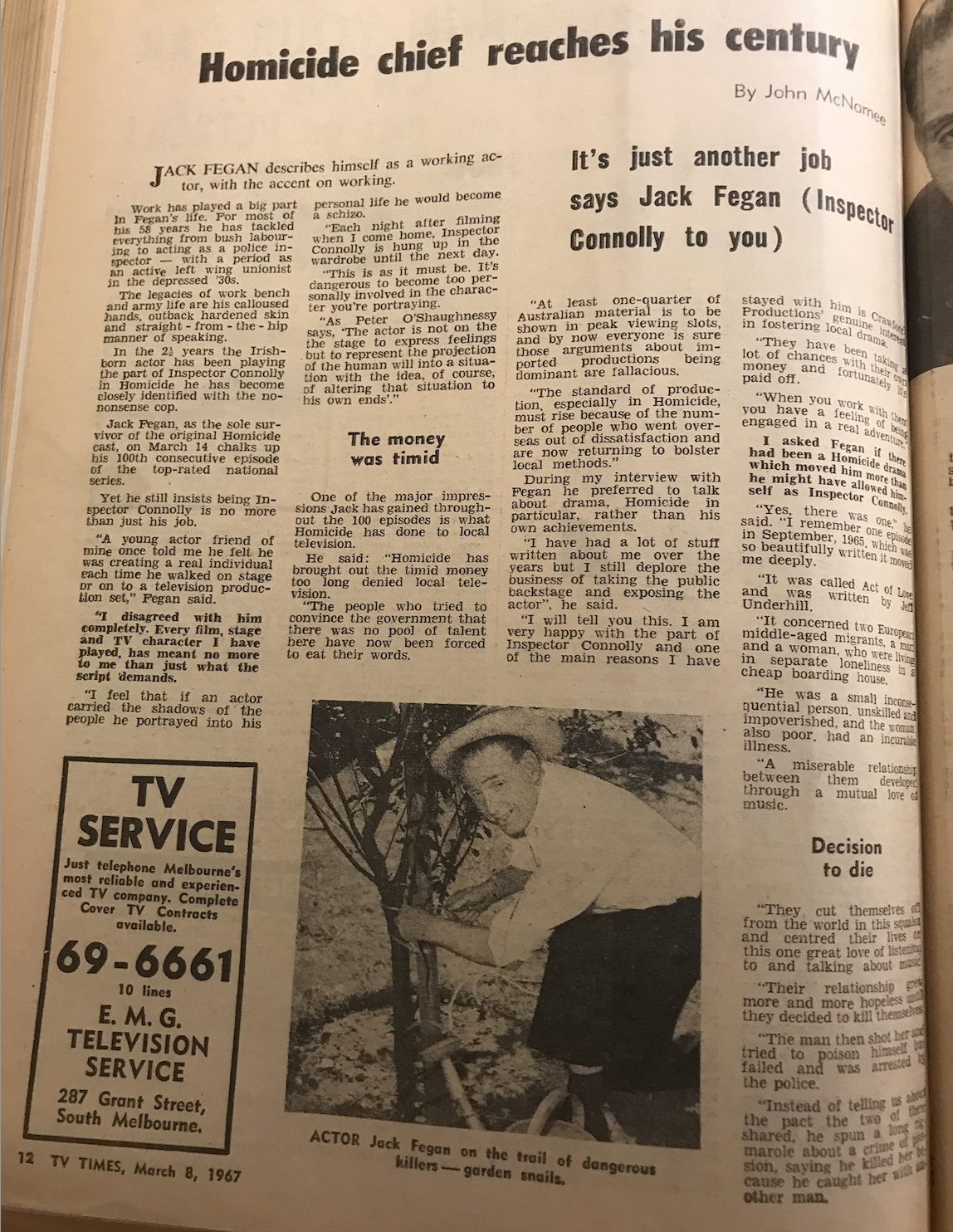
Hector Crawfords said the show was a little bit based on his radio show D24 but was "developed" from that. See here.
Brian Wright spoke to Susan Lever:
I was working at Channel O as an executive when Homicide went to air. Now when Homicide came to air and Hector Crawford started with Homicide everybody thought this is going to be a disaster. This is going to die. Hector had done a couple of television shows which hadn’t worked terribly well and then he came up with this concept of Homicide and Channel 7 in Melbourne, our opposition, put it on not expecting it to be very much of a success. Believe me, Len Major and I, we didn’t ever tell our bosses, Mr Ansett, Sir Reg, but we deliberately put the weakest show we possibly could against Homicide. We tried to let it get our rating for the first few months. It was almost dead in the first year. I’m talking of Homicide. It was pretty bad. Hector mortgaged his house, and pulled all his money out of the bank. Hector had practically no money by the end of the first year. It was all going into Homicide and it wasn’t rating at all. The management Keith Cairns was the General Manager of Channel 7 in Melbourne. Keith bullied his management to give it another year.
During the second year, it suddenly started to gain an audience, and the production started to gain skills. Ian Jones could probably tell you a lot about this. He was involved in it. They-- that audience started to build, and I can remember at Channel O suddenly I discovered looking at the ratings, which we were doing every week, Homicide became the number one show, for the first time in Australian drama had been the number one show in the ratings. I’m talking regularly: week after week after week. This I think was one of the great achievements of those early days.
The public preferred an Australian show to any of the imported shows. Skippy was coming in Sydney about the same time. I wrote for that too. And Skippy was also beginning to get a rating. This was the period when Australian programs were just starting to beat the overseas shows in the ratings. This to us was dreadfully important in those days.
 |
| The Age 15 Oct 1964 |
 |
| The Age 4 Feb 1965 |
 |
| Age 14 July 1981 |
 |


 |
 |


