Showing posts with label Shell Presents. Show all posts

Brett Porter (1913- 1970)

Top television producer.

1933 enters English film industry

May 1948 moved to Australia, worked Commonwealth Film Unit

1950-57 made films for the UN

1959 Two Men of Fiji

1959 Shell Presents - Johnny Belinda, Other People's Houses, They Were Big They Were Blue They Were Beautiful

Thudner of Silence

Pardon Miss Wescott 

Reflections in Dark Glasses

1962 - directed The Runner for ATN-7

1964 joined ABC

1964 did Strong Since the War - directed the doco with Gil Brearly produced see here

1965 producer of Four Corners

1966 - directed doco Three Faces of New Guinea see here

1966 produced Impact 

1966-67 - first producer of Bellbird

1968-69 - produced Pastures of the Blue Crane 

1970 died in Sydney home aged 57


Age 23 July 1970

Vincent Committee

Brereton Teulon Porter, Producer, Visatone Television Pty. Ltd., sworn and examined.
Mr. Osborne.—Will you tell the Committee your qualifications and experience in the film making industry? —I entered the film industry in the United Kingdom in January, 1933 as a cutting room assistant or assistant film editor at 25s. a week at the studios of Gaumont British in London. Subsequently, I graduated to the position of film editor, editing what are now called B pictures. We simply called them feature:,. During the war, after a period in the ordinary army, 1 joined the Army Cinematograph Service whose purpose was to make military training films. There 1 was, first, supervising editor and subsequently, one of the film directors. 

After the war, 1 became personal assistant to a film director who was  making a film in Brazil. In that capacity, Imanaged She location work in Brazil which included a survey to start oil and then the actual filming period. I also edited that film when we returned to England. That was an A picture. I edited another film, a first feature, in England before coming to Australia in May, 1948. In Australia. I joined the Commomvealth Film Unit where I directed some documentary films. I joined Ealing who were working at Pagcwood at that time as film editor.

Then, at the end of 1950, I went to New York where I was on the Staff of the United Nations Headquarters as film writer, director and editor. This position I occupied for about 7 years. During that time we also made films for television and were involved in production of television programmes.

I returned to Australia and. for the Shell Company of Australia. I wrote, directed and edited a one hour feature documentary film called “Two Men of Fiji Then I was transferred to the stalf oi ATN Channel 7 at Epping where I produced a number of live dramas which were sponsored by the Shell Company under the series title of “ Shell Presents.” I also produced and directed other things including a number of episodes of a quarter-hour dramatic scries and a one-hour documentary sponsored by the Shell Company: there was another one hour play which had no sponsor. Those were television productions with television cameras. Subsequently I have worked for Visatone, whereI have made television commercials and have been involved in the production of documentaries, and also for Crawford Productions, a Melbourne firm, where Iwas involved in the production of a series for the Department of Trade called “ Fxport Action Now. with Visatone my primary concern is the production of entertainment material, particularly dramatic scries, by this telecam method.

Children of the Sun (26 Oct 1961) (ITV)

 British TV play based on a 1957 book by Morris West.

Cast

Francesca Annis as Carla
Maria Antippas  as Zizzachiona
Joseph Cuby as Francisco
Griffith Davies as Daniele
Mark Eden as Giovanni Spada
Norman Florence as Mario Borrelli
Brian Hammond as Tonino
Leslie Hart as Giacomo
Robert James as Public prosecutor

Original book

West researched the book over six months in Naples.

The book was West's first international success.  (Although it did not sell well in America.)

It was a best seller in Europe and England and marked a turning point in the career of West. The Sydney Morning Herald said "with this work, West not only found his way as a writer but discovered the theme that would underpin almost all of his subsequent books — the nature and misuse of power. Of the 18 novels he was to write post-1957, 15 are on this subject.

TV adaptation

In 1959 it was announced the show would be adapted for the Australian anthology series Shell Presents. This did not happen.

It was adapted for ITV anthology television series ITV Television Playhouse in 1961. It was made by Anglia TV.


SP#7 - Ruth (5 Sept 1959)

 Version of TV play by John Glennon. Later filmed by BBC in 1962. And US TV in 1960.

Plot

Cal returns to the house next door to where he used to live, looking for Ruth. The resident informs him that Ruth is away sick. 

Cal remembers when he was a lonely man living with his widowed mother who wants him to be educated. Cal just wants to play the guitar.

Cal befriends his neighbour Ruth, a housewife who refuses to sweep floors and dreams of playing Cleopatra. Ruth encourages his dreams to play the guitar.

Neighbours accuse Cal and Ruth of having an affair. Cal's mother asks Ruth to no longer speak to her son. Ruth rejects Cal.

Cal becomes a success. He returns to find Ruth dying in hospital. 

Cast

  • Lyndall Barbour as Ruth
  • John Glennon as Cal
  • Edward Howell as Ruth's husband
  • Jeannie James
  • Barbara Brandon
  • Agnes Dobson
  • Lorna Stirling
  • Murielle Hearne
  • Betty Randall
  • Wyn McAlpin
  • Wyn Pullman

Production

John Glennon was an American writer and director who worked in England. He was only 27.

I'm not sure this was the world debut of the play. Its advertising said it had already been shown in the US and England. But from my research it didn't play on BBC until 1962 and the earliest American review I found is 1960 - the play was called The Dirtiest Word in the English Language.  A 1960 piece here said Glennon left the US for England in 1956 because he was unable to sell his scripts in the US but found success in England. 

In March 1959 he did a play for British TV called The Bird, The Bear And The Actress see here. This March 1959 profile said his first play was sold to CBC while he was appearing on Broadway in St Joan see here. That play may have been called The Movie Star. A review of that from 1957 is here.

It was in the US.

Glennon  arrived in Melbourne on 8 August 1959 to present two plays for GTV-9, starting with Ruth. He was also to help coach Australian writers and producers on US drama techniques. 

Glennon says told the TV Times there was a real Ruth "a young woman who figured once in my life very strongly." Describing the story he said before the male character meetings the woman "he is weak and indecisive, a shallow character, Ruth is wide awake, joy filled woman who makes the boy into a purposeful, energetic young man with stature and decency."

The producers wanted Lydall Barbour to play the lead. She returned to Australia after twelve months away (she appeared in The Exiles in the UK). She was tracked down to a hotel room in Paris and John Glennon travelled from London to persuade her to accept the part. 

"Ruth is a big and heavy role, but a wonderful part," says Barbour. "And it was wonerful to work with John Glennon - he's not only a clever playwright at 27 but a brilliant actor as well." It was one of her first television performances. "I was terrified of it before I went away and would have nothing to do with it." In London she'd appeared in the BBC series The Exiles and an episode of The Flying Doctor.

The play was produced in Melbourne at the GTV 9 studios.

While rehearsing it Glennon said he was working on a play about Australians in London. Not sure what happened to that.

Glennon later made Rope.

In September 1959 Glennon said said there were plays of his he wanted to do in Australia: The Duchess Treatment (was this The Movie Star?) and The Bird, The Bear and the Actress.

Reception

The TV critic from the Sydney Morning Herald called it "a highly original and diverting play" where Glennon's writing was "in an attractively inventive and individual way that sometimes shades into the eccentric". He said "the play's great fault is that its ingredients are too rich for comfortable compression into an hour. It needs more time and space to develop ideas ana incidents too arbitrarily imposed in this production... John Glennon himself... acted very well indeed, with all the variety and range (and not excluding the occasional mannerisms) which The Method can supply."

The Age TV critic wrote that those viewers "who got the message" would have found the play "very interesting. For those who didn't it could have been a bit of a bore... Some sort of tribute must be paid to Rod Kinnear... for tackling what must appear to many as being a very unrewarding play. A complicated autobiographical play can be very hard to 'get across' to viewers. An experience vivid in the mind of the writer is often more difficult to portray through the drama medium than is a story drawn from the writer's imagination... Mr Glennon is now a little too sophisticated for this rather difficult role. Miss Barbour had some highly dramatic moments but, for the one hour, John Glennon gave the more faithful and consistent acting performance." 

Frnak Thring of TV Week praised the acting of Barbour.

Listener In called it "a startlingly different essay in television dramatics... an obscure plot and incomprehensible punchline... falls into a new category of entertainment best described as Beatnik Bellowdrama. Any virtue it had lay in the performances."

 Other versions

It was filmed in the US as the Dirtiest Word in the English Language in 1960. Uta Hagen played the woman.  review is here. A Variety review is here.

Another version aired as a BBC Sunday-Night Play in 1962, starring Constance Cummings, again written by John Glennon, and this time directed by Henry Kaplan.  This report says it was done on US and Australian TV first.

It's rare Australian TV did a play first before the BBC.


SMH 14 Sept 1959


The Age 4 Sept 1959

The Age 10 Sept 1959

SMH 19 Sept 1959


SMH 14 Sept 1959

The Age 27 Aug 1959

The Age 3 S ept 1959

The Age 6      Aug 1959


SMH 13 Sept 1959

The Age 3 Sept 1959

SMH 21 Sept 1959

The Age 10 Sept 1959


LA Times 3 Oct 1960


The Stage 5 March 1959

TV Times 21 Aug 1959


TV Times Vic 28 Aug 1959 p 11


TV Times Vic 18 Sept 1958


Listener In 12 Sept 1950


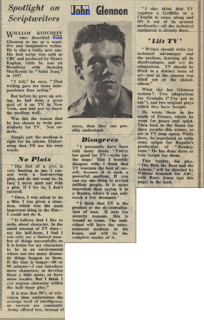
Spotlight on Scriptwriters John Glennon WILLIAM KOTCHEFF once described John Glennon to me as a sensi-ive and imaginative writer. He is also a fairly new one. His first script was sold to CBC and produced by Henry Kaplan, while he was on... E Broadway with Siobahn MacKcnna in "Saint Joan." in 1957. "I felt," he says, "That writing save me more independence than acting." E But before he gave up acting. he had done a great E deal of it on TV in New York, and had got to know the medium well. Was this the reason that he has chosen to write par- ticularly for TV. Not entirely. Simply put: the medium is right for his talents. Elabor- E ating that. I'll use his own words. No Plots E "I he tact ot a plot isvery limiting to me. I can- E not write a fast-moving E plot, and do not want to. In E fact, I never start out with E a plot. If I try to, I don't E succeed. Once, I was asked to do E a film. I was given a situa- tion, which was the most important thing in the film E I could not do it. E It follows that I like to E write about character. In the E small amount of TV time say the half-hour. I find I can only say a limited number of things successfully, so it is better for my characters E to be in an environment E where not too many dramatic things happen to them. If the time is longer 60 or E 90 minutes I can introduce E more characters, or develop E Hum a little more, or have E more locales. But I think I E can express character within the half-hour play." It is true that 50°o of tele-ision time undermines the E average level of intelligence, so viewers are constantly heinu offered less, instead of more, than they can pos sibly understand. Disagrees I personally have been told many times, You're too good for TV write for the stage.' 

This I heartily disagree with. I think that TV warrants the best of my self, because it is such a powerful medium. If you can say one thing to several million people, H is more important than saying it in a theatre, where it can only reach a few thousand.' I think that TV is the product of the dicentralisa tion of man. If only for security reasons, this is bound to come. The indi vidual will have the enter tainment medium in his house, and will he the complete master of it. also think that TV requires a Griffiths or a Chaplin to come along and e lift it out of its present E mediocrity all the technical equipment is already there. 'Lift TV' Writers should write for technical advantages and the medium, learning all its E disadvantages, and not do E adaptations. TV should be E lifted to a distinct form of art just as the cinema was lifted out of the nickelodeon." What else has Glennon written Two adaptations E for Granada I've got to E eat and two original plays which they have bought. He wrote these in the south of France, where he went for peace and quiet Then back to the States for three months this winter, to act in TV soap opera. While there, he negotiated to write E some scripts for Rapallo's production of Rendez- E vous." He has done three or four scripts for them. This Sunday, his play. The Bird, the Bear and the Actress.'' will be directed by r William Kotcheff for ABC, with Barry Jones (see this e page) in the lead.

ABC Weekly 16 Sept 1959


SP#10 - Pardon Miss Westcott (12 Dec 1959)

 Australia's first television musical comedy.

Plot

It is 1809 and Britain sends its convicts to the penal colony of New South Wales. On a convict ship travelling to Sydney, the convicts, notably three men, Mansfield, Harbutt, and Snark, sing "He-ho, you'll never go back".

Elizabeth Westcott is being transported after being given a five year sentence for killing a pig and serving it to a pompous magistrate at her father's inn. On the boat over she meets Richard Soames, an army officer being transferred to the NSW Corps. Elizabeth befriends Mansfield, Harbutt, and Snark after she refuses to report them for theft; they sing "Send for Me" together.

The ship arrives in Sydney. Richard meets the new, temporary Governor, Colonel Paterson, who has taken over from Governer Bligh (the Rum Rebellion has just taken place). Paterson complains about the lack of decent servants and Richard recommends Elizabeth but Paterson is reluctant to employ a former convict.

Elizabeth arrives to track down Richard and impresses Paterson, who offers her the job of managing Government House. She persuades Richard to let Mansfield, Harbutt, and Snark join her as servants. Richard sings "You Walk By" to Elizabeth.

Elizabeth runs the house with great success but this causes the Governor's wife, Lydia, to become jealous and demand the convict leave. Paterson decides to grant Elizabeth a ticket of leave and loans her five pounds to set up an inn. Elizabeth sings "I'm on My Way".[5]

Elizabeth runs the inn, called the Silver Bottle, along with a servant girl, Mog. It is popular but they have trouble with the local soldiers. She decides to gate crash a party held by Paterson and his wife, in order to talk to the Governor. At the party, Lydia sings a song to her guests, "Our Own Bare Hands".

Elizabeth arrives to make an appeal to Paterson, but upsets Lydia. Richard arrives at the party and dances with Elizabeth; he sings her a song, "Sometimes".

At the Silver Bottle, the customers, including Mansfield, Harbutt, and Snark, sing and dance a number, "The Grog Song". The convicts mock Lydia, when Paterson arrives and overhears. He is upset and sends the convicts home. Paterson also tells Elizabeth she and Richard must not see each other, as she would be bad for his career. She briefly reprises "Send for Me".

Paterson tells Richard to not see Elizabeth and he reluctantly agrees. Mansfield, Harbutt, and Snark escape, taking Paterson's rabbits. Sent to find the convicts, Paterson sneaks out to see Elizabeth and they sing a song, "So Much More". Paterson catches the two of them together and demands Richard's resignation; he also orders Paterson to spend the night in prison with the three recaptured convicts.

In prison, Mansfield, Harbutt, and Snark sing "The Whole Shebang", watched by Richard. The convicts escape, during which Richard is knocked out. The convicts deposit Richard and Elizabeth's inn. When Richard wakes up he insists they go back to prison. He and Elizabeth sing "The Argument" along with Mansfield, Harbutt and Snark. The convicts eventually agree to return to their cell.

Lydia is convinced that Elizabeth and her husband are having an affair. The convicts have broken out of prison again. Elizabeth insists she loves Richard. Elizabeth and Richard sing a love duet, "You Walked By".

The convicts arrive, having recaptured Paterson's rabbits. Paterson tells Richard that the NSW Corps is being disbanded, Paterson is going home and Richard is out of the army. Elizabeth has to serve out the remaining four years of her sentence. Mansfield, Harbutt, and Snark are given an extra five years of service, but are assigned to Richard as servants. Mog, the convicts, Elizabeth and Richard sing a final song. 

Cast

  • Wendy Blacklock as Elizabeth Westcott
  • Michael Cole as Lt Richard Soames
  • Nigel Lovell as Colonel Patrerson, the acting Governor of NSW
  • Queenie Ashton as Lydia Patterson
  • Chris Christensen as Mansfield
  • Nat Levison as Snark
  • Michael Walshe as Harbutt
  • Joy Hill as Mog McGuire
  • Don Crosby as corporal
  • Frank Sheldon as Ensign Randall
  • Frank Salter as soldier/guard
  • Bruce Harris as sentry
  • Don McIntyre as Lt Collins
  • Joy Hill, Frank Sheldon, Margaret Abbie, Frank Salter, Paul Munro, Bruce Harris, Dawn Bowden, Don McIntyre, Judy Maxwell, Kevin Fruend, Chris George as dancers

 Production

The film was commissioned by ATN-7 from the writers of the musical Lola Montez, which had enjoyed a successful run on stage. The brief was to create a family musical for Christmas. The budget was £5,000.

The book was by Alan Burke and Peter Benjamin, the music by Peter Stannard, and the lyrics were by Peter Benjamin. Burke appeared "by courtesy of the ABC" who were employing him as a director. 

David Cahill the director says in his NFSA oral history that the lead character was loosely based on Mary Beiby.Her bio is here.

The show was broadcast live from ATN-7 studios in Epping, Sydney. The music was conducted by Tommy Tycho. Kevin Cameron did the sets, Bill Robinson did wardrobe and Vernon Best was operations manager. Ken Shadie did audio. Betty Pounder was borrowed from JC Williamsons to do choreography.

Michael Cole had been fired from Lola Montez. He was hired by the writers for this to make it up to him.

According to Ailsa McPherson, who worked on the show as a script assistant, during the live broadcast the actor who played Colonel Paterson accidentally omitted over a page of dialogue in an earlier scene. The other actors continued because it was live, but it meant later plot points would be confusing. After the show went to air, they re-shot the scene and re-inserted it into the tape and kine.

Alan Burke discussed this with Graham Shirley in 2004.

That grew out of Lola having gone on at The Trust, the Elizabethan Theatre and Channel Seven commissioned us to do a musical for television. The first Australian musical written for television and it cropped exactly as I was about to do Wuthering Heights which wasn’t the ideal time. But the two Peters worked at it and Benj did in fact, not only the lyrics but the book and I came in and sort of edited, it was about all I could contribute to it. It went to air, enormously successful, it was repeated I don’t know how many times. I think it got two repeats which is pretty much unheard of. It was a very handy thing to put on on Christmas Day for instance which they did...
Wendy was nice and oh the lovely Queenie Ashton was marvellous and they’d written a song for Queenie ‘Just Their Own Bare Hands’ which was very sweet about ‘how we built this colony out of nothing and we’ve got cricket pitches and theatres and all these lovely things’. And in the middle section of course ‘we had a little bit of help along the way, but only the tiniest amount, you’ve got to show these convicts that their crimes can never pay, so work done by them just doesn’t count’. Very sweet song, Benjamin at his very best lyrics. So Queenie sang that and we were able to use Michael Cole. I think I’ve told you earlier that he was sacked by the Trust after the Brisbane season of Lola and before we gave him to Sydney but Thank God we’d already made the LP and Michael is immortalised on that for Saturday Girl. But we were able to offer him as it were as the .......(unclear) to Channel Seven and indeed they used him opposite to Wendy and it was great fun, very nice.

Brian Wright told Susan Lever:

So we commissioned our own play: “Pardon Miss Wescott” and Peter Stanard wrote the music. Very good music too. Peter Benjamin wrote the lyrics and the book. We came up with this original comedy about the convict days, and so forth. It was a very big production in its day. It went very well. But that’s also on Kenny recording, and it’s terribly old-fashioned now, but it was the first ever done here. .. I’ve got an LP of the music. ..   It was quite good. I’m rambling on here a bit. ..

We went to air live. We had just got the first video tape recorder in Australia at ATN. We did a lot of firsts in those days. But we’d only had it a week or two, and the producer, Brett Porter, I was the Executive Producer of it, Brett Porter and the director David Carl and I had a long conference. And in our wisdom, we decided not to use the video tape, but to go to air live. Because we thought this would kill the spontaneity of the actor, as we need to have this feeling of going to air live. Well how mad we were. In the second act of the show, Nigel Lovell, playing the governor at the time, Nigel Lovell had two cues, which were identical. A maid came in to tell him that dinner was served, twice cuing Nigel. They’re about 20 minutes apart. In that 20 minutes, it was a very thin little plot we had. Rabbits featured in it. And what happened to the rabbits, happened in that 20 minutes between these two cues. Nigel of course, cut from the first cue straight to the second, and cut the entire middle of the play out! Including a couple of musical numbers, and we had to roll on.

    Now we were Kenny recording that for Melbourne. When the show finished, we re-recorded the second act, and edited it back in. But poor old Sydney can’t have had any idea what the plot was about.

    You can guess what it was about. It was about two rabbits. You can guess what happened.
 

 Songs

  • Overture (orchestra)
  • "He-ho, you'll never go back" - sung by male chorus of convicts at beginning
  • "Send for Me" - sung by Wendy Blacklock
  • "I'm On My Way" - sung by Wendy Blacklock
  • "Bells Suddenly Ringing" - love song sung by Michael Cole
  • "The Grog Song" - sung by taverners at The Silver Bottle
  • "How Could I See?" - sung by Blacklock and Cole
  • "The Whole Shebang" - sung by three convicts (Chris Christensen, Nat Levinson, Michael Walsh)
  • "You Walked By" - sung by Blacklock and Cole
  • "So Much More"
  • "Our Own Bare Hands"
  • "The Argument"
  • "Sometimes"
  • Finale

Reception - Ratings

The Beacon Research Company estimated that 250,000 adults and 10,000 children watched the broadcast. More than 100 people rang in to congratulate on the broadcast on the night it aired. 

It earned a 55% share in Sydney.

Critical Reception

TV Times said it was "really not good enough".

The critic from the Sydney Morning Herald wrote the musical "had an entertaining and beguilingly tuneful premiere in a smoothly organised live production" despite "the lack of colour and space in which create spectacle and the effects which properly, and uniquely-belong to the stage." However:

Nine numbers in a 75-minute show is pretty fair value, and the... tunes and lyrics were fluent, neatly turned and literate. Equally important. they arose naturally from the situations arranged by the... book, and always took the story-line, and characterisation, a step further. And at least one song, "Bells Suddenly Ring" is a possible hit tune. Moreover, the show proved that for those who are willing to use their imagination, there is plenty of theatrical material in our early history... Michael Cole acted and sang very attractively indeed: Wendy Blacklock brought the proper strength of character... but was not entirely at ease with her songs. Nigel Lovell.. was engaging and sympathetic, and Queenie Ashton, his snooty hypochondriac wife, was nicely acid. Chris Christiansen, Nat Levispn and Michael Walshe made a usefully funny convict trio, and Joy Hill danced with considerable verve and enthusiasm.

Cast Album

A studio cast album, with different performers from the television version (apart from Queenie Ashton), was released in December 1960.[

1. 'Overture' (Orchestra);
2. 'Heigh Ho, You'll Never Go Back' (male chorus);
3. 'Send For Me' (Elizabeth, Mansfield, Harbutt, and Snark);
4. 'You Walk By' (Richard);
5. 'The Whole Shebang' (Mansfield, Harbutt, and Snark);
6. 'I'm On My Way' (Elizabeth);
7. 'Grog Song' (chorus);
8. 'So Much More' (Elizabeth and Richard);
9. Our Own Bare Hands (Lydia);
10. 'The Argument' (Elizabeth, Richard, Mansfield, Harbutt, and Snark);
11. 'Sometimes' (Richard);12. 'Finale' (Elizabeth, Richard, and Chorus).

My thoughts. Silly, sweet and fun - a convict era musical made in Sydney by ATN7, from the team who gave us Lola Montez. The songs aren't particularly outstanding, at least not on first listen, but are pleasant. The dancing is very skilled and it's done with high spirits.

I'm really enjoying the direction of David Cahill. It's unobtrusive and skilful; he knows how to change scenes, when to go in for close ups, when to stand back. It's very good work.

smh 7 Dec 1959

The Age 17 Dec1959

The Age 17 Dec 1959

The Age 17 Dec 1959

SMH 30 Oct 1960

SMH 21 Dec 1959

 
SMH 20 Jan 1975

SMH 5 sept 1971

SMH 15 July 1963

SMH 20 Nov 1960

SMH 4 July 1960

The Age 17 dec 1959

SMH 12 Dec 1959

SMH 12 Dec 1959

SMH 19 Nov 1959

SMH 15 Nov 1959

TV Times Vic 18 Dec 1959

TV Times 1 Jan 1960


SP#6 - Thunder of Silence (22 Aug 1959)

 Version of an American TV play by Stewart Stern.

Plot

In the American mid-west, a middle aged farmer (John Tate) and his wife (Marion Johns) give shelter to a refugee from Europe (Richard Davies) and his daughter (Marion Johns). The refugee and the farmer have very different personalities and struggle to understand each other. 

The situation is resolved by the return of Everett, the farming couple's wandering son. 

Cast

  • John Meillon as Everett
  • Richard Davies
  • Marion Johns
  • John Tate
  • John Llewellyn
  • Margo Carrigan

Original play

Stewart Stern based the play on the reallife experiences of farmers in Maryland who took in refugees from Europe. It aired on American TV in 1954 with Paul Newman starring.

Production

Stewart Stern wrote a letter from the USA wishing good luck to everyone connected to the play, and passing on ideas from Paul Newman as to how the role of Everett (the part he played on US TV) should be performed. The letter was read out to the cast the night before the show was recorded. Producer Brett Porter said, "'these words from the author seemed to clarify everyone's conception of the play itself, and they went on to give what I firmly believe is the best production yet in the series."

The play was filmed at ATN-7's studios in Epping. A tape recording was sent to Stern in the US.[

Porter said, "I hope that showing this film, to people like Stern and Newman will prove to people in America that we have, in Australia, actors equal to the best in the world."

Margot Carrigan was in Take a Chance on ATN.

Reception

The TV critic from the Sydney Morning Herald thought the play treated the theme "in the terms of a paperbacked women's novelette" with "sticky flood of sentimentality" and "naive philosophising" but thought Million "did very well to give a tense of life and vitality to a character whose motivation was obscure and whose dialogue, at times, was impossibly trite. Most of the time, his part sounded as though it had been written for James Dean by Ernest Hemingway—with neither of them at their best... David Cahill's direction was fluent and uncluttered."

The TV critic for The Age praised the production's "sound musical judgement" and opening documentary footage of refugees being vetted though felt Meillon "was much too preoccupied wrestling with the American accent" and although felt the play "was good entertainment" wondered why it was not adapted to be set in Australia.

Meillon's performance led to his casting in A Tongue of Silver.


SMH 22 Aug 1959

The Age 3 Dec 1959

SMH 24 Aug 1959

SMH 22 Aug 1959

SMH 17 Aug 1959

SMH 17 Aug 1959

The age 26 Nov 1959

The age 26 Nov 1959

SMH 20 July 1959

SMH 17 Aug 1959


The Age 28 Nov 1959

 
TV Times Vic 11 Dec 1959 p 17

The Sin Shifter (16 September 1962)