Showing posts with label Peter Cotes. Show all posts

GMH - Candida (5 Aug 1962)

 One of the four productions Peter Cotes made in Australia. Based on the play by Shaw.

Premise

Candida is married to Rev James Morrell. 

Cast

  • Joan Miller as Candida
  • Lewis Flander as Marchbanks
  • William Hodge as Burgess
  • Jeffrey Hodgson as Rev Alexander Mill
  • Madeline Howell as Proserpine Garnett
  • Geoffrey King as Morell

Original play

The play was first performed in 1898. It is very popular in part because the title role is so great for an actress.

Production

Joan Miller, Cotes' wife, had performed the title role on the West End in 1953.

The production was shot in Melbourne.

It was one of four productions Cotes made in Australia, the others being Long Distance, Suspect, and Shadow of the Vine. He said he would have made more but for the credit freeze. Cotes made it a year before it aired.

Reception

The TV critic for the Sydney Morning Herald said the production "had all the virtues of brilliant casting and all the vices of poor technique... [it] appeared simply as a televised stage production, without any special reference to the distinctive vocabulary of TV, production itself. In addition, camera work, sound and sets were well below par for the course; camera angles were monotonous and too inclusive_, sound poor, and sets fussily elaborate and consequently distracting. Few will cavil at the quality of the acting, however."

The Bulletin also gave it a mixed review but said it "had a fine period setting, Miss Joan Miller in the title role, and dialogue to match the furnishings."

The Age called it "another example of a brilliant professional at work" although felt Miller "did not however have the impact of her earlier roles." 

LITV thought it was full of "outstanding virtues" and said "it further substantiated the hope that the GMH hour this year will give us the finest series of live drama that has so far been achieved either by the national or commercial channels."

Vincent Committee

In 1963 the Cotes productions were raised by K Cairns in his testimony for the Vincent Committe..

Last year we produced a series of dramas under the direction of a leading British producer whom we brought out from England. That was Mr. Peter Cotes. His actress wife, Joan Miller, accompanied him. We produced three full length plays—Shaw's “Candida”, “Suspect” and •‘Shadow of the Vine”. We also produced a half-hour show called " Long Distance At the time the dramas were produced we were in the middle of the late 1961 financial recession and they had to be put on the shelf until last year when, with the support of General Motors- Holden’s they were shown. The amount it was possible to ask General Motors to pay towards the cost of those plays was something slightly less than half the total cost. In other words, our subsidy amounted to about 60 per cent, of the amount we would be able to recover from the sponsor. 

Do you suggest that you lost money on them?

—Yes. Those figures can be made available if required. 

By Senator Hannan.—Was the play in recorded form and could it have been shown on other channels?

—They were on tape. 

Were they shown on other channels?

—In other capitals. 

And even so you still lost on them?

—Yes, even though the cost to the sponsor was something more than three times the amount that he would ordinarily have to pay for a film. Despite the showing on a number of channels you still showed a loss?’

—Yes. 

By the Chairman.—And the sponsor paid three times as much as he would have paid for a comparable pro- gramme from overseas?

—Yes, on film. 

If you had purchased “ Candida ” on film from Great Britain the sponsor would have been that much better off? 

—Yes. 

And 1 take it that you would have made a profit?

—Yes, if it had been on film. We felt that this was a very impor- tant contribution to this problem of Australian production. The advantages of having a top British producer out here were considerable. His help to our own production people was invaluable although in terms of audience accept- ability I regret to say these plays had a rating of roughly 50 per cent, of the audience of films on other channels. We still feel sufficiently encouraged to be looking at the possibility of doing more drama. 

You had 50 per cent, of the audience for what other type of film?

--The other programme was a Hollywood full length feature. It was the film “For Whom the Bell Tolls”/ But your locally produced film had a good producer?— One of the top producers in England. Better than any other in Australia?—At that time, yes, mainly because of his experience. The three plays you mentioned arc good plays?—Yes. Why were they 1 o poorly received by the public?

—Take “Candida”. I do not think Shaw could he said to be a popular plavwright compared with a feature like “ For Whom the Bell Tolls ”. 

Do you know how much “ Pygmalion ” has earned?

— With respect, that is a very different proposition from “ Candida I suggest that “ Candida ” has earned a lot more than For Whom the Bell Tolls overall?

—I would not know that, hut I would certainly agree about “ Pygmalion 

By Senator Cohen.—“ My Fair Lady ” has probable made more than ‘ Pygmalion has it not?

—Yes. 

By the Chairman,—Can you give us a reason, other than the fact that “ For Whom the Bell Tolls ” was Hemmingway and “ Candida !! was by a gentleman named Shaw and. in your opinion, is not as good drama? Would there be any other reasons?

—No. This, 1 should say. was in a peak time on a Sunday night and was not relegated to fringe areas. It was 8 o’clock on a Sunday night. I think the possible presence of a high factor of youngish people, including possibly children, could have been a factor there. They do exercise a con- siderable control of sets. That could have been a factor, but generally I think in what might be called popular entertainment ” Candida ” at least was no match for the other programme. Unfortunately, we had no measurement of the other plays, although in other cities where we had ratings again the pattern was roughly repeated that the imported film did outweigh by a fair percentage or quite heavy percentage the local production. 

Do you think there is an illogical but nevertheless very obvious and definite public reaction in favour of imported film compared with the locallv produced plav and drama? 

—No. 

Do you think the audience accepts them on their merits? 

—I think we are inclined to under-estimate the capacity of Australian audiences. After all, I believe the Australian audience is getting a television service comparable with, and in many respects better than, anything I know in the world. The audience is very critical and I believe the taste is keen and the judgment good. Whereas in the early days the viewer would watch anything, he certainly will not do so now. He is quite demanding and very vocal and critical—constructively, generally-.and T think he is the greatest safeguard we have. He certainly maintains very consistently that we should improve, and he attempts to tell us how we can improve. T believe that after genera- tions of indoctrination bv American films the Australian viewer is very perceptive.  

In June 1963  George Patterson argued “another factor which has not helped nurture the delicate Australian drama plant has been the tendency of some station managements to kill the completion from an Australian show by putting an imported blockbuster against it.” The example it gave was Cotes’ Candida, which “had no real chance of reaching a worthwhile segment of the available audience” as it was scheduled against For Whom The Bell Tolls, “This is not an argument in favour of ‘protection’ but a plea for greater understanding of issues important to the whole industry.” (George Patterson June 1963 p 13) See below. See TV guide here.


The Age9 Aug 1962

The Bulletin 11 Aug 1962

SMH 6 Aug 1962 p 4

The Age 26 July 1962

SMH 30 July 1962

The Age 2 Aug 1962

GMH People May 1962

The Age 31 May 1962


George Patterson Report June 1963


GMH - Shadow of the Vine (3 June 1962)

 One of the four Peter Cotes productions for HSV-7 (all from foreign scripts). From a play by Beverly Nichols.

Shadow of the Vine was the second one Cotes made and the last one that aired.

Premise

Mark Heath is a once brilliant lawyer who has become an alcoholic, affecting his two sons, Julian and Arthur. Only his wife Lilian remains loyal.

Cast

  • W Edward Hodge as Mark Heath
  • Sophie Stewart as Lilian Heath
  • Mark Kelly as Arthur Heath
  • Edward Brayshaw as Julian Heath
  • Bettina Welch as Janet, Arthur's fiancee
  • Ellis Irving as Dr James Ritchie
  • Lorna Forbes
  • Carole Potter

 Original play

Adapted from a 1949 play by Beverly Nichols.

The original play by Beverly Nichols was based on Nichols' personal struggles in coming to terms with his father's alcoholism. The play had been performed on Australian stages and adapted for Australian radio.

Production

It was one of four productions Cotes made in Australia in 1961 for HSV-7, the others being Long Distance, Suspect, and Candida. The first production shot was Long Distance which was filmed on 18 May 1961. Shadow of the Vine was the second play produced by Cotes.

It ran for 90 minutes.

The show was recorded live in Melbourne on 8 June 1961.  

Cotes made Candida then announced that his production operation was being wound up due to the credit freeze. He made one more production, Suspect, before leaving Australia. Cotes said he read 100 plays by Australian writers and considered making 2, both by Alan Seymour, but neither was made. Long Distance had been screened while Cotes was in Australia but the other three were not shown until 1962, by which time he had left the country. 

GMH announced them in May 1962.

Reception

The Age TV reviewer praised "a sensitive performance by Sophie Stewart" and Hodge's "well-directed portrayal as a drink addicted father... Once again the Peter Cotes touch came through for me. Interesting it was to see how the inside of the house sets helped rather than hindered to put across the realism of the story. Contrast this use of space to the intimate sets usually preferred by some ABC producers... Pity the drama lesson by Peter Cotes, now ended, is in danger of being forgotten. There is no idea of a continuity in drama by HSV-7 in sight, I believe."

It received a positive review from TV Times. 

 Listener In thought it was the weakest of the commercial plays that year, blaming the script.


The Age 11 Oct 1962

The Age 1 June 1962


The Age 4 Oct 1962

The Age 4 Oct 1962

The Age 4 Oct 1962

The Age 24 Aug 1961

The Age 4 Oct 1962

The Age 5 Oct 1962

The Age 6 Oct 1962

The Age 31 May 1962

GMH May 1962

LITV 13 Oct 1962 p 17


GMH - Suspect (3 June 1962)

One of the Peter Cotes productions. It was directed by Ian Jones.

Premise

The son of Mrs Smith (née Maggie Wishart) is about to marry a doctor's daughter. A press baron, Sir Hugo, arrives who thirty years ago covered a trial where Maggie cut up her mother and father with an axe. Maggie claims she's innocent... but is she telling the truth?  

Cast

  • Joan Miller as Mrs Smith
  • Kenneth Burgess as Rev. Alfred Combermere
  • Moira Carleton as Goodie McIntire
  • Michael Duffield as Dr. Rendle
  • Patsy King as Janet
  • Clement McCallin as Sir Hugo
  • Frederick Parslow as Robert
  • Bettina Welch as Lady Const

Original play

It was based on a play by Edward Percy and Reginald Denham which was based on the Sandyford murder case.

Other adaptations

The play had been adapted for US TV in 1948 and 1952 and for British TV in 1939, 1946 and 1958. 

Production

The show starred Cotes' wife, Joan Miller, who had performed in the play on British TV for the BBC in 1958.

It was one of four productions Cotes made in Australia, the others being Long Distance, Candida, and Shadow of the Vine. He said he would have made more but for the credit freeze, which was blamed for a failure to find sponsors. While Long Distance was shown while Cotes was in Australia, they other three were not broadcast until months later.

In May 1962 GMH announced it as part of six Australian dramas to be shown.

Jones told Susan Lever "By that time the television horizons were not terribly promising and I realised to do the things that really fascinated me like drama for example, I had directed one drama in my seven years at Channel 7.  I just resigned.  There was a little bit of publicity about my resignation.  Some job offers came through and the most attractive one was Crawford’s, not the most lucrative but, far and away, the one with the greatest potential."

 Reception

The Bulletin (Frank Roberts) said

Acting for radio was a full-time job, and being completely at ease in their work, the actors could more readily lift their talent in an hour play. This is not so in television. Production costs are too great. There are no everlasting serials to provide steady income and rapidly accumulated experience in the medium. The players in Australian-produced tele- vision drama are therefore ill at ease, or inept, or wooden. The results make horrible viewing, unless we regard them less than seriously. It is the only possible way to look at such a production as “The Suspect”, 90 minutes of lunacy released as a General Motors Hour of Drama, directed by lan Jones, adapted and produced by Peter Cotes, and starring his wife Joan Miller who “repeats the part she played on BBC television a few years back”. 

Their plot was madly dramatic. Thirty years after chopping up her momma and poppa, in Scotland not Massachusetts, Mrs Smith nee Maggie Wishart is about to lose her only son in marriage to a doctor’s daughter. Enter a Press magnate who had covered her trial as a young reporter. It all comes back to him. He tells the doctor, who babbles about the physiology of the thing—genetics, I guess. They confront Maggie. She tells them she is innocent, and describes how it really happened. They believe her. All exit except Maggie, who then applies an axe to a chopping block, laughing hideously. This proper haggis was described as a thriller. It may have been, in the era of Rain, E. Phillips Oppenheim and The Bat. Certainly, most of the cast borrowed their dramatics from a time when over- acting for the silents set the universal style. 

Clement McCallin as the Press magnate qualified for the Silver Ham in 1962, but he was merely the most prepos-terous of a ridiculous bunch in a fusty, trivial play. Condemnation must extend to those who accepted it as suitable for television, billed it as a thriller, designed a set that dominated most of the action, and made this worse by camera work that fre- quently gave the setting nine-tenths of the picture. 

In production, “The Suspect” was treated as a play viewed by cameras, and the players acted accordingly, but with wondrous variations in period styles, delivery and dialects. “The Suspect” was billed in Melbourne as “first of a series of full-length dramas, made at HSV7 by noted British producer Peter Cotes which will be seen in coming months”. If it is any criterion, we are in for a bad time. 

It should be obvious by now that tele- vision demands an entirely new drama, with simplicity its keynote. Anything more is nearly always too much. And this dictum includes small casts, sets that suggest and never obtrude, ideas as direct as homing pigeons while as light on the wing, writing and acting that achieve realism before trying to ascend to poetry, and photography which finds its story in small detail rather than in 23-inch Cinemascope. Snobbery must be the current veil over this obvious truth, which is visible in the best of the imported series. This snob- bery wants us to look back to “theatre” for our values. If Mr Cotes cannot show us good filmed drama, he will be no help at all. Australia has been a traditional grave-yard of overseas and particularly British talent for too many decades to be much impressed by reputation.  

The Age said it "commanded attention."

Listener In thought it was a "run of the mill" play but liked the production. 

Frank Thring thought the direction was better than the play.


The Age 27 Dec 1962

The Age 31 May 1962 Tv Guide p 1

The Age 31 May 1962

The Age 20 July 1961

SMH 3 June 1962


The Age 7 June 1962


The Age 31 May 1962

The Bulletin 16 June 1962

GMH May 1962


GMH - Long Distance (8 June 1961)

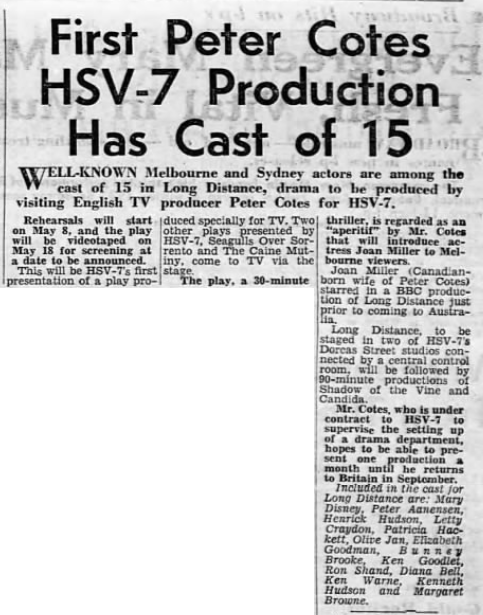
One of those Peter Cotes shows. It was the only one of Cotes' Australian productions to air while he was in Australia; the others were not screened until the following year.

Premise

A woman's husband is to be executed. After finding proof that he is innocent, his wife tries to contact the judge, but only has 30 minutes to do so.  

Cast

  • Joan Miller as Anne Jacks
  • Mary Disney as chief telephone operator
  • Letty Craydon as Mrs Maclean
  • Ken Goodlet as warden
  • Pat Hackett as first operator
  • Olive Jan as second operator
  • Bunney Brooke as Golden Gate operator
  • Ken Warne as room clerk
  • Elizabeth Goodman as San Francisco operator
  • Margaret Browne as Chicago operator
  • Diana Bell as information operator
  • Peter Aanensen as barman
  • Don Crosby as Mr Anderson
  • Kendrick Hudson as Judge Maclean
  • Ron Shand as porter
Original play

It was based on a 1948 American radio play by Harry Junkin, and retained the U.S. setting.  You can hear the 1948 radio play here.

Other adaptations

It was filmed by US TV in 1949, 1953, 1955, 1958. The BBC filmed it in 1958.

Production

It was among the first local drama productions by station HSV-7, and aired in a 30-minute time-slot.

Cotes arrived in Australia in March 1961. It was the first of four productions he made in Australia, the others being Suspect, Candide and Shadow of the Vine. He said he would have made more but for the credit freeze. (In May Cotes announced he would make Shadow of the Vine and Candida and hoped to make Caller Anonymous by Patrick Hamilton),

Overseas versions of Long Distance had previously been seen on Australian TV. Cotes said his main reason for making Long Distance was to introduce Miller, his Canadian-born wife, to Australian audiences. Miller had previously appeared in a production of the play for British TV.  Cotes was in Australia until September 1961 to set up the HSV Drama Department.

There was a cast of fifteen. Rehearsals started 8 May 1961 and it was taped on 18 May 1961. It was filmed in two of HSV-7's studios in Dorcas Street, connected by a central control room. It ran for 30 minutes. The next shows made, Shadow of the Vine and Candida ran for 90 minutes

The air date was pushed back to June 8, 1961 due to a talk by the Prime Minister.

Reception

The Age newspaper, in the section Teletopics, said that "Joan Miller gave a most moving portrayal" and that the show "lived up to expectation"

LITV praised Miller's "virtuoso performance... no actress on the Australian horzon could have matched her performance".

TV Week said it was "a good show".


The Age 15 June 1961

TheAge 4 May 1961

The Age 1 June 1961

The Age 8 June 1961

The Age 31 May 1962

The Age 1 June 1961

The Age 25 May 1961


The Sin Shifter (16 September 1962)