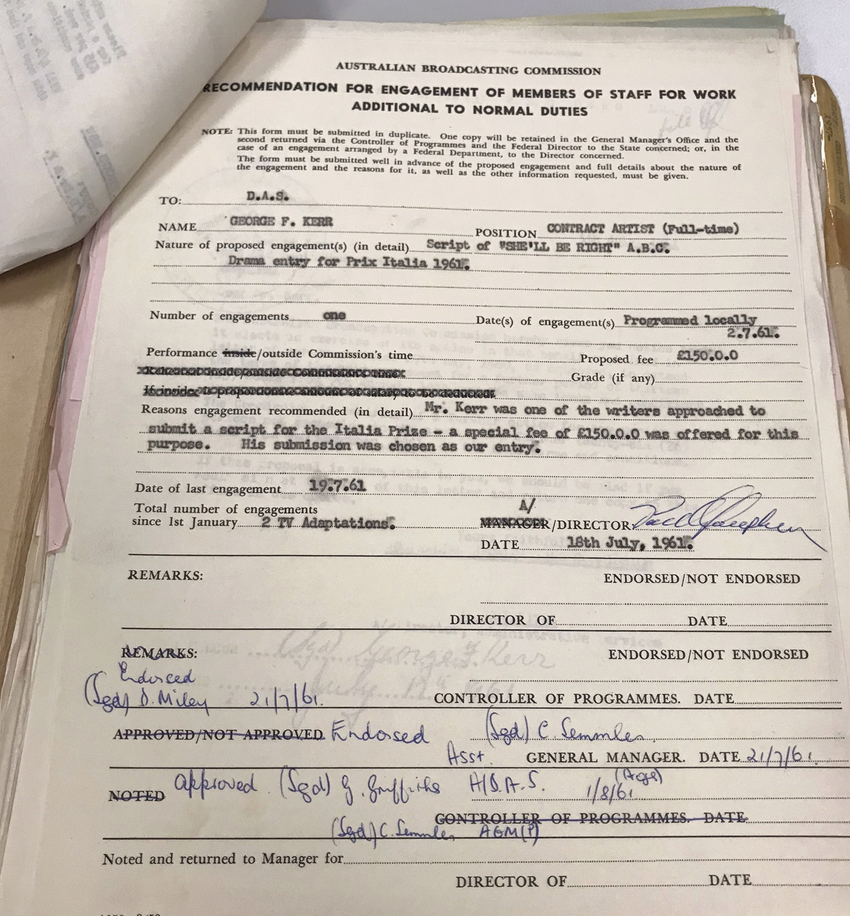
Educated at Merchant Taylors' School. Gt. Crosby, Lanes. Worked as an accountant.
Joined the RASC in the war. Spent five years as a prisoner-of-war in Germany.
On release free lanced as a writer in Paris and Marseilles for Radiodiffusion Franpaise. He wrote feature programmes and short stories there for 18 months
Joined the public relations department of the P and O Line to write their war history, ".Business in Great Waters."
*1950 Wrote a television play, "The Secret Sharer," which was produced by the BBC in 1950. and as a result of which he joined the BBC's drama script department, where he remained for four years, becoming drama script editor.
*1955 At the beginning of 1955, Mr. Kerr joined Towers of London Productions as script editor, and was responsible for many of the scripts in the "TV Playhouse" and Theatre Royal scries. and "Take Your Pick" into one, and added some first-class variety to it.
1956 becomes script editor of ATV.
March 1957 moves to Australia - "on spec" according to memo below. Went to work before David LLoyd James available.
22 April 1957 - starts work at ABC
Feb 1958 David Lloyd James leaves and George F Kerr takes over as script editor (but aways on short contrats0
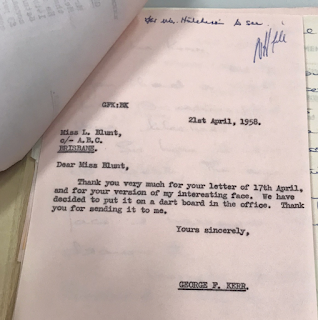
1958 profile on him here.
Aug 1958 says can't find Oz case for Killer in Close up - see here
Sept 1960 writes an article about Australian artistic life here
13 April 1962 - contract with ABC ends
July 1962 back in England working for Armchair Theatre
Sample Credits
*Business in Great Waters (1951) - book
*A Month of Sundays (Aug 1952)
*Jan at the Blue Fox (Oct 1952) - radio serial
*Almost Glory (Apr 1953) - play
*The Voices (Jan 1955)
*Killer in Close Up (Sept 1957)
*The Heat of the Sun (Oct 1957) - radio play
*The Multi Coloured Umbrella (Jan 1958) - TV play (adaptation)
* Red Jungle (June 1958) - radio play
*A Portrait of Dylan (June 1958) - radio play
*The Unfair Sex (Oct 1958) - radio play
*Man (Mark II) (Nov 1958) - radio serial (article here)
*LBW Smith (Nov 1958) - cricket radio serial
*Symphonie Pastorale (Apr 1958)
*Killer in Close Up - Madeleine Smith (Aug 1958)
*Enemy of the People (Nov 1958) - TV play - adaptation
*Count von Staffenerg (Nov 1958) - radio play
*Man in the Grovesnor Hotel (Jul 1959) - radio play
*His Name isn't Rogers (Sept 1959) - radio play - more info here
*My Friend Chisolm (Sept 1959) - radio play
*Anna Karenina (Sept 1959) - radio play
*Blue Murder (1959)
*Remember Bluey (Oct 1959) - radio play - became She'll be Right
*Heart Attack (Jan 1960)
*Farewell, Farewell Eugene (1960) - TV play
*The Last Minute (Apr 1960) - radio play
*Moment of Indecision (Jul 1960) - radio play
*Hunger of a Girl (Sept 1960) - stage play - became Jenny
*Blue Murder (Sept 1960) - radio play
*Ghost of a Day (1960)
*The Dock Brief (1960)
*The Concert (1961) - TV play
*A little South of Heaven (Apr 1961)
* A Night with Winifred (Apr 1961) - short story
*She'll Be Right (Jun 1961) - radio play
*Once Upon a Time (Sept 1961) - radio play
*Jenny (1962) -TV play
*She'll Be Right (Aug 1962) - TV play
*Heart Attack (Mar 1963) - radio play
*Ghost of a Day (Aug 1964) - radio play
*Quick Before They Catch Us (1966) - TV series

Is this country in fact a thriving commercial going-concern — but culturally bankrupt? A.T the present time, Australia’s name in the world is for physical splendour—whether in swimming or sheep-farming, surf, sun or the’ 1,500 metres. Politically. the country is far from being a world power; its leaders cross oceans to bow outside Buckingham Palace or to raise their hats to Ike. Artistically too it is very much the backward child. Not, mind you. through any fault of its artists. Australian painting is making a big noise in London. Every month Australian actors sail from Sydney, headed for the West End—head for it and reach it. Musicians, dancers, sculptors, writefs—once they have learned their craft in their own country, and gone hungry doing so, plunge their small saving on the trip to Europe, there to .sink or swim. And most.of them are now swimming pretty strongly. Think of the names — Pete. Finth, Shirley Abicair, Gilbert Murray, Joy Nichols, Cyril Ritchard, Dick Bentley, Loudon Sainthill, Robert Helpman, Ray Lawler, Judith Anderson — the list goes on till -the crack of doom. No country cân afford such a drain on its cultural life. It isn’t enough to attract to this continent able-bodied labourers. It isn’t enough to dig for oil and conserve water and throw up skyscraping homeunits. Every country must develop its own indigenous culture, must allow for and not despise that small intellectual minority which by means of words on paper, colours, lines, shapes and notes of music will give expression to the ideas and images that are the heart and soul of its people. I feel that until three or four years ago the artistic life of Australia was a bleak enough prospect. But national lifiLmoves in cycles —and slowly. Italian painting, German music, English poetry, French theatre came and went as one century succeeded the next. I am sure that Ray Lavv- Ier’s “Summer Of The Seventeenth Doll” jerked this country out of some of its theatre lethargy. The play pleased its own audiences here, and thenastonishingly—played to enthusiastic houses in England too! People of repute were calling it a “great play”! As indeed it is—or, if not great, then in my opinion the best play written in the English language during the past 10 years. The stimulus of the “Doll” has been extraordinary. It now seems possible that Australians may write Australian plays to hold their own with the works of French, American or English dramatists. There is a chance now that a playwright need not emigrate to England in order to get his work before an appreciative and critical audience. WE need not expect a Brisbane Bach this year or next. It may ,that there will never be Australian music in a big way; England, “a nest of singing birds’’ as far as poetry is Concerned, has been low on music for hundreds of years. America, for years a campfollower of England in theatrical activity, now leads the world with plays of strength and originality and experiment. Can we guess at Australia’s course in the next few years? Or will she stay much where she has always stood, a hanger-on, a buyer of American and English stage imports? Mind you, it is still a slim chance. In this country ‘here are certainly the actors and the writers and the producers. Some of them have not yet booked their passage on the next boat out. But you can be dead sure that they will go—be forced to — if they are convinced that there is no living for thëm here, despite the work of the Elizabethan Trust and the Little Theatres, and the Arts Council and the other striving organisations.
STUDIO PORTRAIT George F. KERR The lean-faced Englishman with the piercing blue eyes leaned forward and said he liked the Australian accent. Always had . especially when spoken by females. A PLAYWRIGHT and a TV and radio script writer, Mr Kerr was tired of England, felt it was used up as far as he was concerned The Australians he had met he liked, and he wanted new surroundings, new stimuli, new people to observe. Since he arrived here 11 months ago, with his voung wife and four-year-old daugh ter Catharine, he has beep writing and adapting TV plays for Channel 2, and working with the A.B.C. drama department. His radio serial “Man (Mark II)” is currently running on the A.B.C. “I was trained as an accountant,” he said, “but the war interrupted 1 didn’t mind, I only started the course to please my parents. “I had always wanted to write, even at the risk of starving.”
During five years as pris oner of war he dramatised Joseph Conrad’s story “The Secret Sharer.” They were going to act it in the camp, but the “D-day” landing in Normandy took their minds off amateur theatricals. Later, when he felt up to tackling the 8.8. C., George Kerr adapted this play for television, and its acceptance led to a staff job. Between his release from the prison camp and this he had been freelancing h France for the American and British departments of Radiodiffusion Francaise He digressed for a moment on “prisoner - of - warshm,” said he had written a comedy about it called “A Month of Sundays.” “I was tired of The Wooden Horse’ attitude.” he said, a bit bored. “I’d rather be a prisoner-of-war than fighting. And it was better for the British Army: I wasn’t a very good soldier. “A PRISON camp is something like a monastery. Or a university college.” He looked around him “l could do five years in this room. 11 wouldn’t upset me.” In the camp he studied for a London University degree in French “organised through the Red Cross”—and only the Normandy invasion prevented him taking his final examinations. “I also learned to play the flute,” he said. “One of my fellow prisoners was a flautist in the London Philharmonic Orchestra. But I don’t play it any more.” Mr Kerr began talking about playwriting. Studying the plays of Noel Coward, Bernard Shaw, Tchekov and Oscar Wilde helped him most, he said. “Dialogue from Coward,” he explained, “thought from Shaw, wit (if any) from Wilde, and humanity from Tchekov.” But, like Alexander Pope, he believes that “the proper study of mankind is man.” “When I observe people it isn’t their surface motives that interest me,” he said, “but their real motives, and when you’ve got at those you have a play.” He is planning a series of TV portraits of Australians. “Not historical characters,’ he hastened to say. “hut types I’ve met: The girl from Toorak’ whom 1 encountered in Melbourne, The Man in on.” the Canberra plane, and so And a stage play on Syd ney’s social life, set in Belle vue Hill. “I’ve been asked to do an Australian version of Ibsen’s Enemy of the People.’ ” he continued. “I think it’s a splendid idea, don’t you? A Queensland Gold Coast set ting, a new town being built, and water pollution. Basically the same story as Ibsen’s.” Mr Kerr 'doesn’t plan to stay much longer in Sydney, but to move on to Queens land. right up to the far north, then to Perth and Tas mania. “
T’VE heard about * the ‘weird convict atmosphere’ there,” he said. “It would make a good set . 4 in?* After Australia it will probably be South America (“but there’s not much scope there for earning a living”). So the United States will be come inevitable. Then, eventually, he hopes, if he ever takes roots, it will be at Aix-en-Provence, in France. “Being so far away from France is the only thing I mind about Australia,” he re marked. He doesn't think this kind of life will interfere with Catharine’s education, but ad mitted that his wife hankers a little for a real home. “She’s many years younger than I am.” he said. “Men who’ve been prisoners of war, they say, always marry their mothers or their daugh ers. I chose my daughter. “She was 17. I had been coaching her for her school certificate,’” he added, “and she failed, so I married her.” At the moment she is help ing in a shop in Rose Bay, while Catharine goes to kindergarten. “We’re living in one room in the Cross,” he explained, “and I treat it as my office from nine to five. A freelance writer must observe a regular routine.”
We asked George F. Kerr Q. Since you re an Englishman , why do you pronounce your name “ Kurr ” and not “Karr “’? A Because my family were originally Scottish. In Scotland it is really “Kair-r-r-r,” and the only other people I know who say it like that are the French 0. Do you go in for sport? A. Golf about once a year. And I used to play cricket, but never the horses. Q. Your favourite food? A. Continental cooking, with wine. But I don’t like espresso coffee; I prefer tea.
 |
NAA George F. Kerr
|
 |
| NAA George F. Kerr |
 |
| NAA George F. Kerr |
 |
NAA George F. Kerr
|
 |
| NAA George F. Kerr |
 |
| NAA George F. Kerr |
 |
| NAA George F. Kerr |
 |
| NAA George F. Kerr |
 |
NAA George F. Kerr
|
 |
NAA George F. Kerr
|
 |
| NAA George F. Kerr |
 |
| NAA George F. Kerr |
 |
| NAA George F. Kerr |
 |
| NAA George F. Kerr |
 |
| NAA George F. Kerr |
 |
NAA George F Kerr
|
 |
| NAA George F Kerr |
 |
| NAA George F Kerr |
 |
| NAA George F Kerr |
 |
| NAA George F Kerr |
 |
| NAA George F Kerr |
 |
| NAA George F Kerr |
 |
| NAA George F Kerr |
 |
| NAA George F Kerr |
 |
| NAA George F Kerr |
 |
| NAA George F Kerr |
 |
| NAA George F Kerr |
 |
| NAA George F Kerr |
 |
| NAA George F Kerr |
 |
| NAA George F Kerr |
 |
NAA George F Kerr
|
 |
NAA George F Kerr
|
 |
| NAA George F Kerr |
 |
| NAA George F Kerr |
 |
| NAA George F Kerr |
 |
| NAA George F Kerr |
 |
| NAA George F Kerr |
 |
| NAA George F Kerr |
 |
| NAA George F Kerr |
 |
| NAA George F Kerr |